0 comment(s) so far. Please add yours!
 The story of Inez de Vries unfolds through a constellation of documents—some official, drawn from the prim and unforgiving files of Saint Clare’s School for Girls; others more intimate, taken from the journals, letters, and scribbled notes of the girls themselves. Some will appear typed and orderly; others retain the texture of handwriting, rendered in a cursive-style font.
Readers are invited to step into the role of archivist, assembling the story from these traces, and imagining the lives that fill the gaps between pages—the tensions, the alliances, the secrets too dangerous to write down. Not everything will be explained. But Inez is watching. And she remembers.
Note: Comments are read and much appreciated. Much as I like reading them on Twitter and Bluesky, I love getting them here, and promise to respond. Moreover your ideas and reactions also join the archives, where they may quietly shape what comes next..
Archivist Foreword
The document that follows was written in the back seat of a carefully maintained Humber on the afternoon of 12 July 1955, shortly after its author had been summoned to the Headmaster’s study at Saint Clare’s. Although Gladys Williams was no longer a pupil of the school, this distinction proved to be of limited practical importance.
Readers familiar with the school story will recognise the situation without difficulty. A former girl returns, meaning well, and finds herself required to explain her conduct, to wait, and to remain present. The rules, once learned, are not easily forgotten, and are applied with particular confidence to those who ought to know better.
This entry does not attempt to set out the facts of the incident in full; those are recorded elsewhere, and in proper order. What Gladys provides instead is a running account of the afternoon as she experienced it: the Headmaster’s study, the formalities observed, the tea tray, the silences, and the journey that followed. She writes quickly, with feeling, and at some length. This too will be familiar to readers of school diaries.
With this entry, the Saint Clare record pauses. Lessons resume, bells ring, and the school continues. The account that follows travels on.
The MP Visits Saint Clare – Previously posted
Gladys’ Diary
12 July 1955
Later (the Head’s Study; continued in the car)
I won’t forget today, no matter how old I get or how many pages I scribble. Ghastly. Utterly ghastly. There were so many awful bits I can’t even decide which was the worst, nor which to write first. Now that we are back on the road I am writing as fast as I can, partly so I don’t have to look up. If I don’t look at him, perhaps Gerald won’t speak to me. I can feel him watching me over the tops of his papers, but I go on as if I were completely absorbed.
Instead of letting me slink away after that wretched drive up from London, Gerald marched us straight down the dim corridor to the Head’s study. The cabbage smell clung to the walls and our shoes echoed like a sentence already passed. He opened the door, stood back, and waited for me to go in first, as if I were being presented for inspection. We weren’t expected — not then — but he behaved as if the place had been waiting for him all along, papers under his arm, that terrible air of purpose he puts on when he’s decided something. I think Miss Kelley tried to say something, but I barely caught her eye before I was all but pushed into the Head’s office.
Mr Lewis blinked at us from behind his spectacles, plainly surprised to see a party from London descend on him without warning. Gerald merely inclined his head and said, smooth as you please, “A word, if you please.”
The Head invited us as if we had not already imposed ourselves, and then, almost absurdly, rang for a tea tray with sandwiches .
These niceties over, Gerald turned on me, using that dreadful low voice of his, the one that weighs more than shouting ever could.
“Miss Williams,” he said, quiet and clipped, “I wish you to tell the Head exactly what you have done.”
There was nowhere to look. My heart sank straight through my shoes. I am not a pupil; I have not been one for years. And yet there I stood, spluttering and stammering like a schoolgirl hauled up for passing notes. Gerald would have none of it. I had to admit everything: Clarissa’s letter with Inez’s enclosed, the request to send it on to her mother, my saying yes, my writing a cover note and posting them off to Lady de Vries. I told it in silly little scraps, and every bit felt worse once the Head had heard it. The words slid out like stones, and the room, large though it was, felt very small as the shelves of books seemed to close in around me.
When I finally finished, Mr Lewis did not address me at all, but remarked, almost to the furniture, “Ah, so that is how she knew.” The “she” was certainly not me.
Then, more formally, he straightened in his chair and addressed us both. He was polite, firm but almost apologetic, and said the School could not possibly condone letters carried privately. He paused and added (as I could have told him) that as I am no longer a student, my part in the matter was not his affair, but one to be settled between my brother-in-law and me.
Gerald nodded, but replied that he wished the matter on record, and asked that Clarissa be called.
Mr Lewis went to the door and asked Miss Kelley to have a prefect bring Clarissa to his office. We heard her give instructions to “Fairfax” — a prefect, I suppose — just as one of the kitchen maids came in with the clattering tea tray. Then, adding to the whole Lewis Carroll feeling of the afternoon, the Head apologised for the tray’s “meagre fare,” offhandedly blaming our sudden appearance for leaving the kitchen unprepared.
What followed was an extreme bout of conversational awkwardness. He talked about anything except what we were really there for: the heat, the gardens, the fête already past, the coming holidays. His small talk sounded thin and nervous to me. Gerald answered in kind, dry but courteous, as he ate sandwiches and drank two cups of tea. I never touched mine. No one seemed to notice. Everyone else was fed. The silences between the men grew longer and heavier until they felt like stones piling up. Despite the tea, my mouth was completely dry, and I contributed nothing.
After what felt like hours, but was probably no more than twenty minutes, Clarissa arrived, walking through the doorway as if to her doom, her legs so embarrassingly bare and vulnerable in her field hockey skirt, grass stains still on her knees. I saw the shock on her face when she took in Gerald and then me, sitting there together. Her eyes were huge and round. I heard Miss Kelley say something low to the prefect as Clarissa crossed the threshold. Mr Lewis remained at his desk.
Gerald didn’t waste a moment. After the briefest of greetings, he took Clarissa through the same wretched confession he’d forced out of me, making her tell the Head exactly what she had done. My stomach clenched and I was glad I hadn’t touched the tea. I felt her eyes on me, begging for help, but I couldn’t meet them.
I won’t pretend I listened to every word. I heard her first stumbles, the brave little resolves, the determined refusal to betray Inez. Clarissa would not, could not, name her. Gerald repeated my admissions for her benefit and scolded her for involving me, his voice dry and clipped, as if this were all part of a lesson that needed to be properly understood. Mr Lewis sat very straight in his chair and said nothing, nodding only occasionally.
When it was done, the Head stood, cleared his throat, and spoke with that careful, official politeness of his, saying he was satisfied he understood the situation. He added that the School could not be party to further discussion of family discipline, and that Gerald was welcome to make use of the study. Then, murmuring something about other duties, he left the room.
The door shut behind him and, just like that, the air changed. We were alone.
Gerald didn’t raise his voice; he didn’t need to. He slipped, as he always does, into that long, dreary lecture that follows what he calls serious misbehaviour, making Clarissa tell him again where she’d gone wrong and what she ought to have done instead. I shut my eyes for that part and wished, quite uselessly, that I could stop hearing.
I know this bit of the business far too well, and I suppose Clarissa did too, though perhaps not quite yet. It always moves the same way, no matter the room, no matter the offence. First the talking, then the pause — and then he begins to look about him. In the Headmaster’s office there wasn’t much to rearrange.
I watched him draw a large armless chair into the centre of the room. My knees went hollow. I’d known, really, how this would end from the very start, but until that moment I hadn’t quite believed it would be allowed to happen there. I don’t think anyone ever does.
At last he said the thing — “Punished at school means punished at home” — as if it were a maxim and not an excuse. Before I properly understood what he was doing, he was already giving the order, sharp as a pistol crack, telling her to get over his knee. When she hesitated he scolded her and ignored her pleas. Right there in front of me, in front of the Head’s desk and all those old books, she had to put herself across his lap.
And then he spanked her. Not gently, not as a symbol, but a proper hard spanking, knickers down, the way he used to when I was fifteen and thought myself too grand to be called on the carpet.
I had to stand there and watch. My knees shook. Clarissa begged him not to spank her there, not at school. She promised she’d be good. And all I could think was how it had felt when it was me: the sting of Margaret’s old Head Girl hairbrush, the sick shame of being dragged down from my airs and made small. I felt it all over again, though he wasn’t touching me.
For a moment she held out. Then the sharper smacks told us his hand had found bare skin, and she broke. Sobs, pleas, promises — all of it spilled into that room. I kept my eyes fixed on the floorboards, as if that could make it less real, but the sound came up through my shoes.
Part of me wanted to shout at him to stop. Another part knew I had no right, since it was my fault she’d been caught in the first place. And another, beastlier part, was almost glad that Clarissa finally saw what her dear Papa can be like, and that Gerald always makes good on his word.
Suddenly Gerald’s voice changed. It went soft and coaxing, calling her his girl, proud and sure. I knew that voice too; I had heard it over my own tears.
Then the hard one came back as he finished it with a little speech, each sentence, each word, driven in by another smack, no matter how she sobbed.
“You will give Mr Lewis no further trouble. For the two weeks left in this term, I expect to receive nothing but good reports.” Then, pronouncing her doom, “And have no doubt, young lady, we shall conclude this matter at home.”
When we came out, poor Clarissa walked ahead of us, still crying, trying her best not to rub the seat of her games skirt. She moved so stiffly I was sure she was very sore. I felt wretched leaving her like that. I wanted to beg Gerald to stay an hour, so we could hold her and bring her back to herself, but I couldn’t find my voice. Her cheeks were wet, her head bowed, and she stood as stiff as the naughtiest child. We managed a couple of quick, awkward goodbyes and left her with Miss Kelley. As we went, I prayed she’d be sent to the infirmary rather than straight up to House. Anyone who saw her would know at once what had happened.
And I — a grown-up lady of twenty-five, or so I tell myself — walked away feeling smaller than the smallest mouse. Sulky, hot-faced, wanting to slam doors and shout UNFAIR until the rafters fell in. But I daren’t. Not when Gerald was that sure of himself. I could all too easily picture him deciding to smack me on the lawn, in front of the Humber, for good measure. No, thank you.
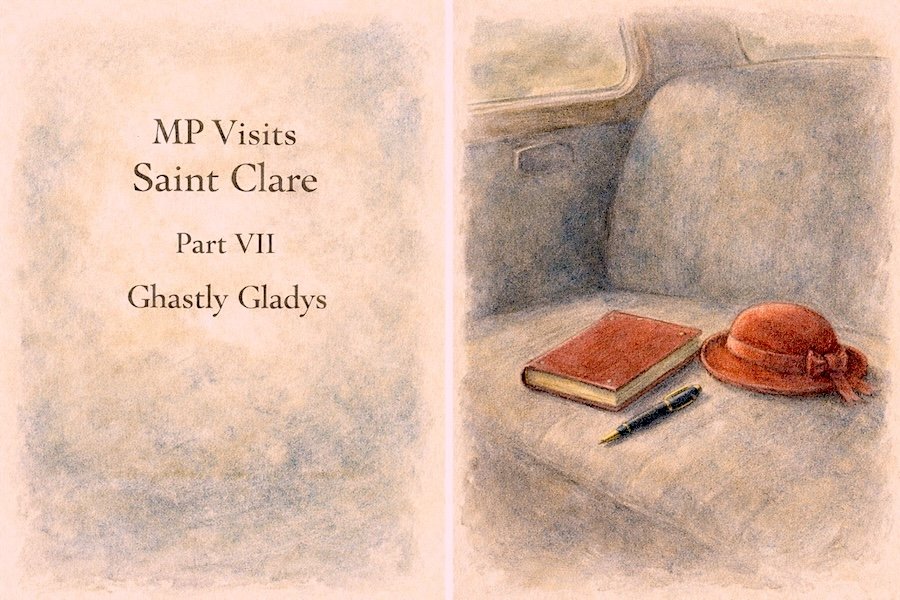
So I straightened my back, smoothed my skirt, picked up my gloves, and walked out to the car with all the dignity I could muster. Gerald unfolded his papers at once. Fowler started the engine. I opened this notebook and kept my head bent over the page.
Only this notebook knows better.
Oh, Maggs, what would you say if you saw me? What would you do?
Afterword
With this account, the Saint Clare record closes for the afternoon.
The gates shut; the timetable resumes; the incident is absorbed into routine with the quiet efficiency of an institution long accustomed to absorbing such things. Officially, the matter is concluded.
Gladys — ghastly Gladys, however — is still writing.
The next entry continues her diary for 12 July 1955, composed later that same day after the return to Bryn Derwen, when witnesses have dispersed, supper has been served, and the expected response is neither protest nor explanation, but fortitude.
She mustn’t grumble.