1 comment(s) so far. Please add yours!
Filed belatedly in the Saint Clare Archive Room, Lower East Wing (Door sticks; mind your fingers.)
Archivist’s Note №0: On Optimism
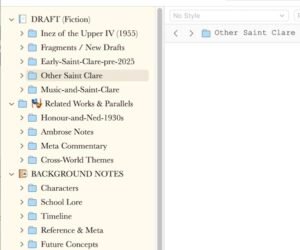
This November began with a plan that, in hindsight, displayed an admirable optimism and a truly reckless ignorance of scale: I intended to move the entirety of my Saint Clare writing into Scrivener, that elegant, beguiling piece of software whose beauty has lured me back again and again like a siren calling from a very aesthetically pleasing rock.

I convinced myself it would take …oh, a weekend? A long afternoon? Perhaps two pots of tea?
It did not.
What followed was a full-scale archaeological expedition through twenty-five years of stories, fragments, experiments, timelines, drafts, doodles, false starts, and worldbuilding ephemera, all scattered across my digital landscape in a manner best described as “enthusiastically feral.”
Thankfully, I was not alone.1Which, had I been, frankly I would have curled into a weeping ball before abandoning the plan. A number of very patient members of a certain spanking fiction Discord server offered structural wisdom, folder hierarchies, and moral support. And ChatGPT (who, whatever one thinks of AI overall, deserves hazard pay) burned the midnight oil with me as we attempted to devise a file system capable of housing a school that has been expanding and building back on itself since 1999.
The Archivist observes that this endeavour, though wildly underestimated at the outset, has proven both necessary and heroic, and will likely be cited in future staff meetings as an example of “proper archival zeal,” though she refuses to say by whom.
Only once this digital excavation was complete (or at least, complete enough) could November’s real work begin.
Only then did #AdAstraWriMo dare to commence.
Saint Clare November: 42,924 / 50,000 words
Across November, I wrote and revised just under 43,000 new words, and the unified Saint Clare Scrivener project crossed the 100,000-word threshold with another ~200,000 words still waiting to be added.
Now that December has settled in and put its cold nose against the windowpanes, it is finally possible to look back at November with the proper mixture of satisfaction, disbelief, and a strong desire to reorganize the stationery cupboard. What began on October 31st as the ceremonial reopening of the Saint Clare gates for #AdAstraWriMo became, by month’s end, a surprisingly architectural endeavour: walls rebuilt, floors relaid, entire wings reconnected.
Archivist’s Note №1: On Word Count Inflation
Surpassing 100,000 words has not reduced paperwork. If anything, several documents appear to be… multiplying. Inez’s diary is now claiming territorial rights over two shelves and a hatbox.
Much of the work was archaeological: retrieving scenes that had fallen behind digital radiators, consolidating timelines, and coaxing the Honour and Ned materials into something resembling linear time. Though no instalments of their series were posted publicly this month, the amount of research and drafting devoted to them was considerable. It’s the kind of subterranean work that rarely shows above ground until suddenly, in December or January, something significant blooms.
Archivist’s Note №2: The Honour and Ned Wing
Formerly classified under “Active Chaos,” this collection has been promoted to “Promising Disorder.” The Archivist requests patience. And possibly biscuits.
Alongside the fiction, November included a rigorous supplement of what Saint Clare’s catalog calls “Contextual Studies” but the Archivist insists on calling “External Distractions.” These were, in truth, vital:
- A full watch-through of Downton Abbey (for the first time!), which proved unexpectedly useful for calibrating tone, class choreography, interwar emotional vocabulary, and the particular art of descending staircases with news both grave and thrilling.
Archivist’s Note №3: On the Downton Effect
Several staff, including Matron, appear to have adopted a “Carson stance.” This is being monitored.
Books
And then: the books. A great many books. A November so saturated with debutantes, spies, secret codes, and family secrets that the Archivist considered issuing ration cards.
Fiction Reads in November
- Balogh, Mary – The Ungrateful Governess – A Regency tale illustrating how governesses, when sufficiently provoked, can upend entire households with nothing but moral fortitude and a well-placed silence.
The Archivist notes its relevance to understanding staff power dynamics, which remain as treacherous in 1955 as they were in 1815. Particularly instructive for crafting Saint Clare teacher backstories, and for imagining precisely how a seemingly meek woman might ruin a man’s day using only propriety. - Georgie Blalock – The Last Debutantes – A chronicle of the final season before the lights go out.
Archivist’s warning: Handle with care; nostalgia is flammable. This bit of historical fiction offers the precise atmosphere needed for Honour’s cohort… all glitter on the surface while the floorboards creak ominously underneath. - Rhys Bowen – In Farleigh Field – Aristocrats, sabotage, secrets in the hedgerows. Fantastic fun! The Archivist approves.
Offers a model for depicting how “important national events” collide with rural tranquility. Saint Clare is no stranger to such events. - Hannah Byron – The London Spymaker – A brisk tutorial on clandestine operations, especially those conducted by women who cannot be trusted to stay in the drawing room.
Highly relevant for any MI6-adjacent business the de Vries family has been concealing behind those polished vowels. - Julian Fellowes – Belgravia – Fellowes delivers his usual parcel of secrets, velvet drapery, and the soft rustle of hidden motives. The Archivist recommends this as a structural guide for crafting intergenerational mischief, something Saint Clare has in abundance.
- Brianne Moore – A Bright Young Thing – A scintillating primer on the hazards of Being Presented to Society.
Archivist’s assessment: Most useful for charting the emotional topography of Honour’s world — champagne bubbles floating over deep chasms of expectation. Readers are warned not to inhale too closely; class pressure can be intoxicating. - Kate Morton – The Forgotten Garden – A multi-generational tangle of secrets, lost documents, and mysterious relatives. Highly recommended for offering understanding of ways archives acquire the stories no one meant to leave behind.
The Archivist has made several exasperated noises while reading it (mostly envy). - Kate Quinn – The Rose Code – A lively account of codebreaking, secrets, and women who refuse to sit quietly on the sidelines of history. The Archivist expects this history to prove highly instructive for the Honour-and-Ned materials, for reasons that will become evident as certain files are declassified. She also observes that several Saint Clare alumnae would have made formidable cryptographers, especially if told they were not permitted to. As for the question of whether any member of the current staff once served in similar capacities, the Archivist declines to comment.2She merely straightens a folder marked “K.” and moves on.
- Isabella Valeri – Letters from the Dead – A most unsettling (and therefore highly useful) novel in which the past haunts the present. Novel has the air of a dream and is, happily, the first of a series of novels. The Archivist notes that its treatment of memory, guilt, and the inconvenient persistence of the written word is directly applicable to Saint Clare’s archives, where several documents have similarly refused to stay quiet. Particularly instructive for crafting the emotional undercurrents of the Honour & Ned years, given the way old correspondences can haunt, clarify, or incriminate, and for reminding the writer that words, once written have a habit of outliving their authors’ intentions. Further, at over 480 pages, my hardbound copy could serve as a useful kudgel 3The Archivist declines to confirm whether any Saint Clare files have behaved likewise.
-
Jacqueline Winspear – Maisie Dobbs – The entry text for a wonderful detective series. The Archivist notes that this text is ideal for understanding individuals who have known both war and peace and find neither entirely restful. Particularly relevant to Ned, who absolutely carries more history in his pockets than is good for him.
Non-Fiction read in November
- Anne de Courcy – 1939: The Last Season – A beautifully detailed record of Britain on the brink.
Vital for staging Honour’s final prewar months — the dresses, the dances, the approaching sense of doom that everyone pretends not to notice. The Archivist notes: Nothing ruins a ball like impending global conflict. - Anne de Courcy – Debs at War – A striking chronicle of debutantes becoming drivers, codebreakers, and women who stepped into critical wartime roles without hesitation. Essential for envisioning Honour and her cohort as they navigate the moment when society’s expectations transformed overnight and the “girls” transformed with them. The Archivist would like it recorded, for the benefit of any future Head Boys reading over our shoulders, that these accomplishments were achieved without the benefit of an Eton education. A useful reminder, she feels, that competence has never been the exclusive property of any one male in a striped tie.
- David Kynaston – Austerity Britain – A monumental social history of the immediate postwar years, chronicling everything from bombsites and ration books to political reinvention and the small domestic triumphs of making-do. For Saint Clare, this volume is indispensable. Its insight into postwar everyday life informs the emotional and material world that shapes staff, parents, and students in 1955. A must for any writer attempting to chart how the war’s aftermath shadows even the most polished corridors. The Archivist particularly recommends it for reconstructing:
– the lingering shortages still felt in 1955
– the clash between old expectations and new realities
– and the quiet determination of households (and schools) to rebuild dignity from frayed cloth and ingenuity. - Angela Lambert – 1939: The Last Season of Peace – A clear, steady look at Britain in the final months before WW2. The months shaped by parties, picnics, and social rituals carried out with the uneasy knowledge that their time was passing and might not come again. It captures the peculiar mental climate of the upper classes at the time — that blend of we must pretend nothing is wrong and we know everything is changing, a psychological weather pattern my characters necessarily inhabit. The Archivist finds this volume especially useful for reconstructing Honour’s last prewar summer: its rhythms, its unspoken fears, the subtle tension between carrying on and looking over one’s shoulder. Also invaluable for pinpointing the instant when “the world as we know it” gives way to “the world as it must become,” a hinge moment the Honour & Ned narrative will soon need to pass through.
- Mary S. Lovell – The Sisters – My second of two Mitford texts, this one with even more detail, gossip, and political catastrophe. The Archivist recommends it for constructing complicated sibling dynamics, a skill that applies equally to aristocratic families and Saint Clare dormitories.
- Virginia Nicholson – Singled Out – A powerful, humane account of the “surplus women” of post–World War I Britain, the millions for whom widowhood, loss, and demographic imbalance reshaped every expectation of adulthood. The Archivist regards this as required reading for the school’s staff files: many a Saint Clare mistress carries exactly the sort of private history this book illuminates, especially those who returned from war service with quieter wounds and unexpected independence. Offers invaluable grounding for understanding Miss Kelley, for the Honour-era future of many classmates, and for understanding the reshaped social terrain into which many of the 1955 staff were born.
- Jane Ridley – George V – A surprisingly vivid royal biography offering insight into duty, decorum, and the national habit of saying everything except what one means. Useful for writing Saint Clare’s older staff, many of whom came of age under such regimes. Found unexpectedly moving.
- Adrian Tinniswood – The Long Weekend – A sweeping, room-to-room tour of interwar country-house life, complete with collapsing fortunes, stubborn rituals, architectural woes, and the steady hum of modernity pressing at every mullioned window. The Archivist suggests this as essential scaffolding for understanding the houses, habits, and hierarchies that shaped Honour’s and Ned’s youth – from the dining-room choreography to the desperate attempts to maintain grandeur while the roof quietly leaks. Provides a generous supply of atmospheric detail for Saint Clare’s wealthier families, many of whom still pretend their long weekends never truly ended (despite the evidence).4Added a lot to watching Downton Abbey too.
- Laura Thompson – The Six – A vivid, unsettling, and downright operatic study of the Mitford sisters — six women who managed, between them, to span the entire political spectrum, rewrite the rules of notoriety, and turn family life into something between a salon and a battlefield. The Archivist recommends this volume for anyone attempting to understand how brilliance, charm, loyalty, defiance, privilege, recklessness, and ideological wildfire can coexist inside a single family.5Or school, as the case may be. Particularly informative for shaping the world around Lady de Vries and any Saint Clare alumnae inclined toward dramatic convictions, fashionable extremism, inconvenient romances, or the lifelong habit of causing a stir wherever sent.
Archivist’s Note №4: Debutantes + Espionage
A naturally complementary pairing: social sparkle meets strategic secrecy. The Archivist observes that when these volumes are placed beside one another, they demonstrate an unexpected kinship. Certain alumnae were very much the same.
Archive Record: Posts Filed in November 2025
Presented in chronological order, as all reputable archivists (and some prefects) insist.
- The Music of Discipline: Notes Toward a Sonic Saint Clare
- New Story: The Angel Ruston
- The MP Visits Saint Clare: Prologue – The Institute and Its Discontents (11 July 1955)
- Correction Corner # 1
- The MP Visits Saint Clare: Part I – 8–12 July 1955
- The MP Visits Saint Clare Part II – The Road to Saint Clare
- The MP Visits Saint Clare Part III – Gladys Williams’ Return
- The MP Visits Saint Clare Part IV – Heard From the Outer Office
- The MP Visits Saint Clare Part V – Clarissa in the Infirmary (1)
Archivist’s Note №5: Classic Editor Incident
Logged under “Sentimental Technology,” though in truth the situation was far more operatic. In the course of migrating materials into Scrivener, the Archivist was obliged to process:
- BBEdit fragments,
- Word documents in every conceivable state of formatting distress,
- Apple Notes entries written at baffling hours on MacBook, desktop, iPhone, and, in one memorable case, watch
- Evernote refugees,
- PDFs of uncertain provenance,
- Several A5 notebooks
- And several hundred small, handwritten scraps whose survival defied both logic and humidity.
Final tally: 400+ text files, 1,000+ images, and a Classic Editor duplicate that arrived like a ghost insisting it still had business in this world. No reprimands issued. The Archivist merely notes, with a certain weary dignity, that she still prefers ink.
Archivist’s Note №6: Concerning Workplace Conditions
Following the successful migration of BBEdit fragments, Word orphans, Apple Notes midnight ramblings, Evernote exiles, mismatched PDFs, and over a thousand images (not to mention the small scraps of paper written in handwriting that can only be described as “hopeful”) the Archivist has filed a formal request for workplace compensation.
Grounds cited include:
- emotional fatigue,
- optical strain,
- several near-miss papercuts,
- and the spiritual injury caused by encountering filenames such as “final_FINAL_reallythisoneipromise_2c.docx.”
Claim pending. The Archivist awaits judgment with the dignity of a woman who has wrestled a hydra and reshelved its heads.
Closing the Ledger
November was a month of discipline, excavation, research, and tea consumption of heroic proportions.
Archivist’s Note №7: On Tea, Coffee, and Other Necessary Fuels
November’s consumption records have been subjected to the usual scrutiny.
Tea usage reached a level not witnessed since the Great Staff Conference Dispute of 1947, while coffee intake rose in direct proportion to the number of files refusing to behave themselves.
The Archivist wishes it known that her professional functioning depends on a carefully balanced regimen:
– tea for patience,
– coffee for courage,
– biscuits for morale,
– and the occasional square of emergency chocolate for existential crises provoked by unsorted metadata.
Administration, after reviewing these findings, has approved additional supplies of all categories.
(The kettle and the percolator have requested alternating shifts.) Despite the elevated beverage consumption, the Old Girls’ return, and the increased foot traffic in the Archive Room, the inkpots remained mostly cooperative.
The groundwork laid in November (particularly within the Honour & Ned Wing) should begin to bear visible fruit in December, provided no further documents attempt escape or rewrite themselves when the Archivist isn’t looking.
The Archivist has now placed two paperweights on the most volatile files, just in case.
Archivist’s Note №8: December’s Arrival
Never trust a month that hums to itself.
Archivist’s Note №9: Final Annotation
No documents were harmed in this update. Except that timetable. Which was shredded and, I would argue, was overheard snickering on more than one occasion and so absolutely deserved it.
And with that, the November ledger closes. December is already loitering in the corridor, hands behind its back, pretending innocence.
- 1Which, had I been, frankly I would have curled into a weeping ball before abandoning the plan.
- 2She merely straightens a folder marked “K.” and moves on.
- 3The Archivist declines to confirm whether any Saint Clare files have behaved likewise.
- 4Added a lot to watching Downton Abbey too.
- 5Or school, as the case may be.
Curious which spanking fiction Discord server you are referring to. I recently joined one (run by Emma) and found the invitation to another (DFic) but that invitation has expired. I’m trying to find community to improve my writing.