
0 comment(s) so far. Please add yours!
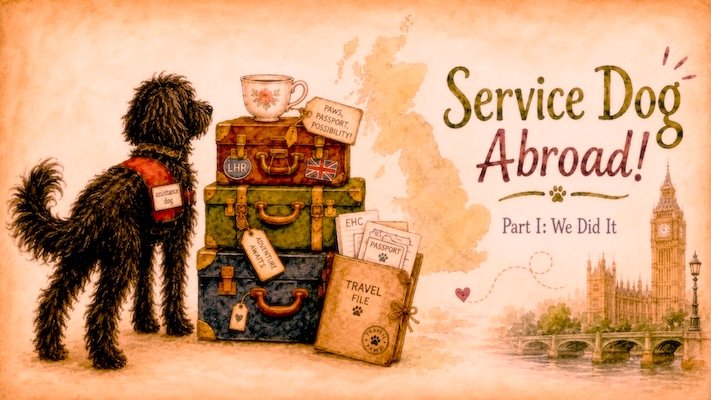
Since Sutti and I first travelled to the UK and Ireland in Summer 2025, and especially since we returned to England (just England this time) in March/April 2026, a number 1Higher than four, lower than forty-two (so far anyway).of people have asked how I managed to fly with Sutti in the cabin to London.2Questions from friends and blog readers. Heck, even the travel-certificate team at Sutti’s vet’s office asked if I’d write something they could use with future clients.
Short answer: we did it.
The slightly longer3Long, long, longest. answer is that flying to the UK with an assistance dog in the cabin 4Throughout this series I’ll use assistance dog rather than service dog. Sutti is an American service dog under the Americans with Disabilities Act (ADA), but when you’re dealing with the UK the relevant term is assistance dog. That’s the language used by the UK government, Heathrow Animal Reception Centre (HARC), airlines, and Assistance Dogs UK (ADUK). In the UK, the term service dog is generally used for what Americans would call working dogs—for example police dogs, military dogs, search-and-rescue dogs, and similar animals. Using the terminology of the country you’re travelling to makes it much easier to find the correct guidance and avoids a surprising amount of confusion. is entirely possible, but it’s less like following and completing a checklist than managing a small project. Both times, getting it done involved Sutti’s veterinarian, my doctors, an international travel-certificate service, United Airlines, Heathrow Animal Reception Centre (HARC), Sutti’s trainers, and completing many, many checklists. Each has its own requirements, deadlines, paperwork, and questions. Some steps depend on others. Some have to happen weeks before you travel. Others can only happen a few days/hours before departure.
Once I stopped looking for The Checklist That Could Explain Everything and started thinking of the process as a set of connected tasks, the whole thing made much more sense. The paperwork wasn’t trying to ruin my life. Really. Rather, I was handed six spinning plates, only each one came with instructions saying it couldn’t be spun until two of the others were already in the air. Perfectly straightforward.
I’m writing this series in the hope it helps someone else navigate the process. Rather than trying to squeeze everything into one impossibly long post,5My first draft was more than 8,000 words long, plus attachments. I’ve broken it into a series of shorter ones.6There will likely be four. Or maybe five. Certainly at least three. This first instalment is about what the process looked like from the other end: Sutti and me actually on the plane, with all those spinning plates somehow still in the air. Next, I’ll go back to the beginning and start explaining what and where those plates actually were.
Before we go any further, one important caveat:
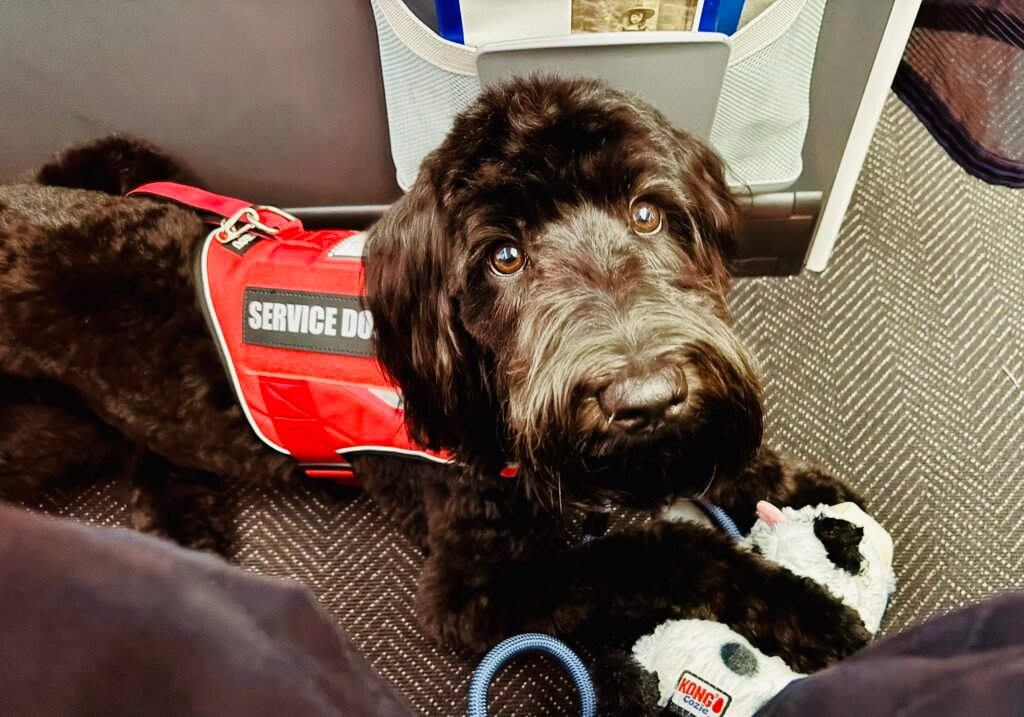
What follows is the process as I experienced it in March 2026, travelling from Los Angeles to London Heathrow on United Airlines with my assistance dog, Sutti.7Sutti is a 33-pound, spayed female Wheaten Terrier–Poodle cross, often called a “Whoodle” (yes, really). She received 18 months of service dog training and assists me in managing PTSD and panic attacks without medication. Airline and airport regulations, policies, and procedures change all the time. Anyone planning a similar trip should always check the current requirements with the organisations involved.
We’re Landing
The cabin lights came on gradually, waking the sleeping passengers to the cramped, artificial morning of the plane. We’d just flown over Greenland.
At my feet, Sutti shifted. For most of the flight, she’d been curled in the floor space in front of the empty middle seat beside mine. United had eventually cobbled together a workable compromise: an aisle seat for me in Premium Economy, with the middle seat kept empty to give Sutti more floor space. It worked, but ten hours is a long time to fold a 33-pound dog into even a slightly larger patch of floor. I’d tried for weeks to get a non-emergency bulkhead seat, where she’d have had more room, but none were available. After two months of planning, phone calls, paperwork, and requests, this was the arrangement we’d managed.
I watched her as closely as she watched me. Had she slept enough? Was she calm? Was she uncomfortable? Did she need water? Did she need to toilet?
She hadn’t drunk anything since we boarded, politely refusing offerings of water and ice cubes. As ever, she’d also refused to use the airport relief area before the flight. Her fortitude amazes me. Given that I’m a woman in my late fifties with a bladder the size of an orange, I needed the toilet. But getting out meant disturbing her, moving her out of the way, finding another passenger to hold her leash, and then resettling her in the narrow space. We’d done that dance a few hours earlier; now it was too close to landing.
Since Sutti waited, I waited too. The plane was already descending.
- 1Higher than four, lower than forty-two (so far anyway). ↩︎
- 2Questions from friends and blog readers. Heck, even the travel-certificate team at Sutti’s vet’s office asked if I’d write something they could use with future clients. ↩︎
- 3Long, long, longest. ↩︎
- 4Throughout this series I’ll use assistance dog rather than service dog. Sutti is an American service dog under the Americans with Disabilities Act (ADA), but when you’re dealing with the UK the relevant term is assistance dog. That’s the language used by the UK government, Heathrow Animal Reception Centre (HARC), airlines, and Assistance Dogs UK (ADUK). In the UK, the term service dog is generally used for what Americans would call working dogs—for example police dogs, military dogs, search-and-rescue dogs, and similar animals. Using the terminology of the country you’re travelling to makes it much easier to find the correct guidance and avoids a surprising amount of confusion. ↩︎
- 5My first draft was more than 8,000 words long, plus attachments. ↩︎
- 6There will likely be four. Or maybe five. Certainly at least three. ↩︎
- 7Sutti is a 33-pound, spayed female Wheaten Terrier–Poodle cross, often called a “Whoodle” (yes, really). She received 18 months of service dog training and assists me in managing PTSD and panic attacks without medication. ↩︎