1 comment(s) so far. Please add yours!
Many thanks to the helpful beta readers The Preacher’s Wife and @paulatnorthgare. They both say this is fine, so any remaining mistakes anyone (Becca)) finds are obviously their fault. I thank them for sticking their… necks… out so kindly.
Seriously. though, I currently need eagle-eyed proofreaders even more than usual as I’ve had to have reconstructive surgery on my ankle and tendons with less than a week to prepare. More on that later, except to say that there has been too much of the not-fun-kind-of-pain Because of said pain there has also been some narcotic pain medication. Oh and the discovery that being on temporary disability (apparently I can’t teach on heavy meds with my foot higher than my heart) is way more stressful and at least as much work as doing my job.
More whining about that later.
Introduction
The papers gathered here belong to the wider Saint Clare archive and sit alongside the documents already familiar to readers of the Inez de Vries sequence: detention essays, staff memoranda, prefect minutes, household logs, and the private writings that have a habit of surviving precisely because no one quite knows what to do with them.
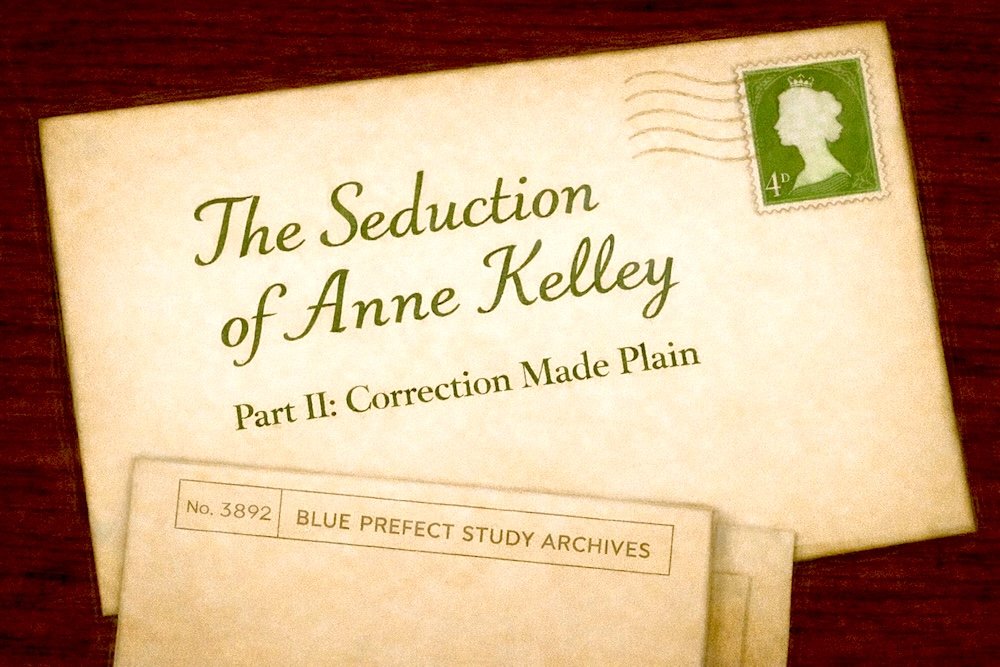
The Seduction of Anne Kelley draws from the Kelley–de Vries correspondence, preserved in the Blue Prefect Study papers, where material that is neither wholly private nor entirely official has long been kept. You will find letters meant to be burned, copies retained “for reference,” and drafts that should by rights have been torn up but were instead saved, retied, and filed under headings of optimistic vagueness. Some pages are neatly typed, as though the truth might be made more palatable by proper margins. Others arrive in the swift, unsteady cursive of someone writing under pressure, or in a place she very much ought not to be.
The sequence opens, deliberately, near the middle of things. In July 1955, Anne Kelley, a Saint Clare’s English mistress, writes a letter to “Gwennie” with the ease of long practice. Only afterward do we return to the beginning, to see how their correspondence formed, why it was encouraged, and what it made possible.
Readers are invited to take up the archivist’s task, and the investigator’s pleasure, of weighing what people say they intended against what they were, in fact, doing. Much will be implied. Little will be stated outright. Those accustomed to the School’s “special friendships” may notice familiar patterns resurfacing in adult form: the same hierarchies, the same alliances and intimacies, and stakes rather higher than dormitory gossip ever required.
These letters trace the development of that correspondence, from proper parental enquiry to something more deliberate, conducted quietly over time in the familiar idiom of the School. For those who prefer their archives with a guide, a brief introduction to the principal actors has been provided, in the manner of a proper dramatis personae. The archive remembers. And so, of course, does Inez.
Previous “Seduction of Anne Kelley” posts:
Comments are warmly welcomed. While I enjoy seeing them on Bluesky and Twitter, those left here become part of the archive proper, where they may quietly shape what follows. I cannot promise the archive is obedient, but it is, as ever, attentive.
Having trouble reading? Try the plain text version.
Archivist’s Foreword
The letters that follow were written in early 1948. By then the novelty of beginning school at Saint Clare’s had worn thin, and routines had settled enough to reveal their effects. Correspondence between Lady Gwendoline de Vries and Anne Kelley was established and less formal. Outwardly, their subject remains Lady Gwen’s daughter, Inez de Vries, recently returned from her Christmas holidays.
Readers may already sense a shift. Attention moves, almost imperceptibly, from conduct to pattern, from incident to structure. The exchange remains courteous, but its purpose a bit sharper.
These letters are preserved among the Blue Prefect Study papers, arranged in neat stacks, organized by year, tied and retied with faded green silk ribbons, and filed under “Private.” They are offered not as evidence of misdeeds or indiscretions, but as records of how trust develops through encouraged affection.
Lady Gwendoline de Vries
Abbey House
2 February 1948
Dear Nancy,
I trust your Christmas was a delightful affair, suffused with its usual gaiety and good-natured merriment. Forgive my intrusion regarding my daughter, Inez. I have some small concerns following her brief return home for the holidays, and wondered whether you had observed any corresponding change as she settles again into Saint Clare’s.
During her time here, the household staff observed that Inez was less attentive to her room than has been her habit. In some respects, her standards appeared to have slipped rather than improved, falling below those she maintained even two years ago. The housekeeper remarked that she seemed uncertain how to make her bed properly or to hang a dress as expected. Her punctuality, too, was less exact than usual, a change I noted myself. None of these lapses were of any consequence in themselves, but their consistency was sufficient to attract comment and to create unnecessary work for others.