3 comment(s) so far. Please add yours!
And we’re back in 1955. Sorry about the time traveling. Context is in Foreword below.
The story of Inez de Vries unfolds through a constellation of documents—some official, drawn from the prim and unforgiving files of Saint Clare’s School for Girls; others more intimate, taken from the journals, letters, and scribbled notes of the girls themselves. Some will appear typed and orderly; others retain the texture of handwriting, rendered in a cursive-style font.
Readers are invited to step into the role of archivist, assembling the story from these traces, and imagining the lives that fill the gaps between pages—the tensions, the alliances, the secrets too dangerous to write down. Not everything will be explained. But Inez is watching. And she remembers.
Note: Comments are read and much appreciated. Much as I like reading them on Twitter and Bluesky, I love getting them here, and promise to respond. Moreover your ideas and reactions also join the archives, where they may quietly shape what comes next..
 Foreword
From the Archivist
We open with Miss Gladys Williams at the end of a day that began far too early and went downhill with impressive speed. The St Albans Institute had little patience for her, and she had even less for it. This evening entry preserves the results: indignation, exhaustion, and a level of offence that could be measured with school rulers if one were inclined.
Her morning at the Institute on 11 July 1955 offers our first glimpse—at least in this sequence—of a girl, well, a young woman, whose capacity for trouble is exceeded only by her capacity for surprise. Nothing dramatic occurs, but the atmosphere is unmistakably primed.
Readers joining us midstream may wish to revisit the earlier Saint Clare entries that converge upon this moment:
The Elwood Files — the failed attempt to slip Inez’s letter past the school authorities.
The Lady and the Headmaster — in which Lady de Vries learns just enough to become dangerously perceptive.
The Secret Letters, Part I — where Gladys first involves herself in a correspondence she might have been wiser to avoid.
Melodrama by Post — ending in Clarissa’s own very revealing postscript.
Heard in the Charrington Household — Miss Gladys, hauled home from Scotland, is made to “answer for herself.”
Gladys in Trouble — Gerald’s formal terms, Gladys’s formal compliance, and the informal tears that followed.
The Charrington Papers, of which the present collection forms a small but telling part offer a glimpse into the anxieties of an English household in the mid–twentieth century. The documents gathered here—letters, annotated responses, and private jottings—capture in miniature a struggle over authority and propriety between Gerald H. Charrington, Member of Parliament and self-appointed patriarch, and his sister-in-law, Miss Gladys Williams, a young woman who had the misfortune to combine a lively disposition with a poor instinct for discretion.
These episodes form the quiet prelude to the tensions now gathering just out of sight. What follows in this entry—indignant, tired, and brimming with offence—is merely the overture.
In the meantime, a wee hint. Look closely at the 1938 Honour’s Game posts and consider where Ned and Honour’s little “game” may have carried Lady Gwen by 1955.
Note: If you’re struggling with the font, here is a plain text version.
Gladys’s Diary – 11 July 1955
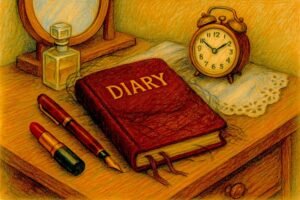
11 July 1955
It’s after 11 PM but I can’t sleep and my head and heart are so full I can hardly stand it. No, I can’t stand it. I’m writing this in the hope of making sense of it. Though it may be I’m just talking to myself.
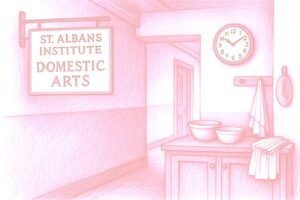
This morning was Gerald’s humiliation exercise number one: the Institute. He marched me there, hand on my arm like a ward in chancery, and handed me over to the Head as though I were a new pupil. Rather than leave me alone to discuss this, he then stood by while Mrs Perris discussed timetables and subjects as though I’m ten years old. Timetables! For me! And what an utterly wretched timetable it is.


 But Inez is watching. And she remembers.
 This tale follows
  – Sit where you are seen, not where you are heard.