1 comment(s) so far. Please add yours!
When I wrote about my summer 2025 spent roaming the British Isles with faithful Sutti , I mentioned announced whirled about in excitement, with the news for my birthday I’d finally acquired the new school uniform of my dreams and worn it to Whitby Abbey.

and I said there was a reason this particular uniform mattered so much to me beyond the obvious fact that it’s exceptionally good-looking. I’ve been meaning to explain ever since, although the explanation turns out to involve nearly thirty years, the early online spanking community, two summers in Edinburgh, a long-vanished department-store tea shop, the first Saint Clare story, and one school tie that crossed the Atlantic before Paul and I had ever met.
The story of this gorgeous uniform begins in Spring 1997. Paul and I had only recently started corresponding. He was a graduate student in Edinburgh, I was beginning my MA/PhD in Los Angeles, and neither of us had yet met anyone from the online spanking community in person. Most of the people who mattered to us there existed primarily as words on a screen: names, voices, jokes, arguments, stories, opinions, and personalities, all of them vividly real and yet still somehow beyond the edges of ordinary life.
Around that time, a newsgroup couple with a Daddy/daughter relationship posted an account of a trip to Britain during which they’d gone shopping for a school uniform in Edinburgh. The “daughter” wanted a proper UK-style uniform, and together they’d visited a shop, chosen one, and taken it away with them. The completed uniform included the school’s blazer, kilt, and tie.1
When Paul read the post, he realised that they might have walked rightt past them that day without knowing who they were.
That possibility thrilled us both, because these weren’t merely names appearing in a newsgroup thread. They’d been walking through Edinburgh, crossing bridges, passing shops and school gates, moving through the same part of the city where Paul was going about his own day at the same time. It “proved,” if you will that the people in ASSville had bodies and itineraries. They literally could be standing next to you at a crossing or ahead of you in a queue, wholly recognisable in one world and complete strangers in another.
As it happened, the couple didn’t remain strangers to us. The daughter and I corresponded, and, a few years later Paul and I spent the day with them at Disneyland. Beyond this I’m not going to name her or reproduce their old post here. It survives in my archive and is part of my history, but this isn’t my telling their story. It’s the story of what the uniform she bought 1997 means and meant to me.
The uniform is for an old school in the center of Edinburgh. It’s a coeducational day school wwhose pupils ranged from very young children (like 4 or 5) through the end of secondary school (17-18). What makes it especially powerful for me is they wear the same distinctive uniform across all those years. All the girls wear the same blazer, tie,2 and tartan kilt — and there is the power for me. I love (and always have) that continuity. I’ve always had a thing about uniforms, and it’s the uniformity matters to me as much as the individual garments do. There is something thrilling about seeing little children and nearly grown sixth-formers wearing recognisably the same clothes, as though the uniform connects them not only to one another but also to generations of pupils before them.
Plus, objectively it is a beautifully striking uniform.3

One of the first school things Paul sent me when we were writing each other about uniforms (we did that a *lot*) was this school’s distinctive stripped tie — it’s always been a favorite. Plus, that means I’ve been wearing a part of that specific uniform since long before I had any realistic prospect of owning the kilt or blazer. The tie crossed the Atlantic while our relationship was still being made largely out of email, letters, phone calls, post cards, and parcels. For years it remained a fragment of something I wanted but couldn’t yet have.
When I visited Edinburgh in 1999, I saw pupils wearing the uniform for myself. When school’s over for the day these kids OWNED the center of the city — you’d see them everywhere, and, best I’ve heard, that’s still the case. So even by summer 1999 this uniform already had a lot of influence based on these the early months of my correspondence, the couple’s post and their proximity that day to Paul which had fed the larger discovery that people we knew online could, and had, stepped into our off-line lives. I wanted this uniform so very much, lthough wanting it and being able buy it were, in 1999, two quite different things.
At the time, Paul and I were both poor graduate students, so the cost alone put a complete private-school uniform beyond either of our reach, and money wasn’t the only barrier. I was heavier then, and had already learned finding and buying clothing my size in British shops was impossible.4 That feeling shaped the way I travelled, because I packed as though anything forgotten might be impossible to replace, and for me it often seemed that way. More recently I’ve wondered whether my overpacking has roots in the not irrational fear that I couldn’t simply walk into a shop and buy another shirt, dress, or pair of jeans had I needed them.
Once, when I said to Paul, “I can’t fit into anything,” he corrected me.
“They don’t have anything that fits you.”
I’ve remembered that. A small shift in grammar, but it moved the failure away from my body and back onto the shops that didn’t accommodate it. The clothes or lack thereof weren’t proof that there was something wrong with me; they were clothes that hadn’t been made available to me. That distinction matters because I don’t want to tell this story as though the happy ending is that I eventually made my body worthy of a particular skirt and blazer.
Besides, those summers I didn’t come away from Edinburgh with nothing. Some of the more generic pieces were possible, and Paul bought me school shirts, knee socks, a straw boater, and a satchel.I had kilts and sweaters. Thanks to Albert Prendergast there have always been gymslips and knickers.5 I began assembling the outlines of the schoolgirl world I wanted, even if the particular kilt and blazer I loved remained out of reach, at least I already had the correct tie waiting among those pieces.
And then there was Aitken and Niven. Scroll down to #11 for a photo of the uniform department circa 1972,
In those days, Aitken and Niven had an extraordinary school-uniform department in Edinburgh. About two-thirds of the floor was given over to uniforms, with racks of blazers, kilts, shirts, and ties arranged by school, school lists and photographs, and proper boarding-school trunks stacked around the walls. The remaining third was an old-fashioned tea shop, because apparently someone had decided that the fitting-out of schoolchildren should be followed immediately by tea and cake.
I must’ve had tea there twenty times over that summer and the next, sometimes with Paul, sometimes with MollyB when she visited us, and sometimes on my own. It became one of my Edinburgh places, somewhere I could settle in comfortably while surrounded by the uniform I wanted and couldn’t afford. I was obviously not from around there, which may have helped, and 1999 was the summer Harry Potter became inescapable, so an American visitor fascinated by British school things probably didn’t seem especially strange.
The women working the uniform department never made me feel I shouldn’t be there. They didn’t treat my interest as ridiculous or intrusive, and let me wander for hours examining the kilts and blazers, admiring the trunks, asking questions, buy a tie or badge, and return again without being made to feel that I was trespassing. The barriers were money and size, not their kindness, and that distinction matters to me now because the shop itself wasn’t a place where I was rejected. It was a place where something I wanted remained unavailable, but where I was still allowed to linger near it.
Two-thirds school uniforms and one-third tea shop may, in retrospect, have been the most dangerously Mija-specific retail arrangement ever devised.
Because I couldn’t buy the uniform in 1999, I did what I’ve often done with things reality refused me: I wrote my way into them. That year I wrote “Tessa’s Summer Uniform,” the first story set at Saint Clare, in which a deeply unimpressed schoolgirl is taken to an old-fashioned department store to be fitted for a complete new uniform. The uniform floor contains blazers, kilts, school supplies, and trunks stacked high around the walls; an experienced saleswoman knows the schools, the uniforms, and their histories; Tessa’s mother remembers being fitted there herself; and after everything has been bought, altered, and endured, there is tea.
The fictional department store isn’t exactly Aitken and Niven, but it’s there. So’s the 1997 newsgroup post, and the uniform I wanted and couldn’t have. As well as memories of shopping for uniforms with my mom and grandma in the 1980s. Saint Clare began as a daydream in Aitken and Niven’s tea shop, long before it became a school with generations of pupils, prefect minutes, staff memoranda, detention essays, family histories, and an archive large enough for me to lose things in. Saint Clare began with a uniform department, a difficult schoolgirl, and the idea that being properly kitted out symbolized opening the door to a world.
In retrospect, I didn’t quite know how much of my own longings for uniformity and belonging went into that story. Tessa resists the story’s gingham summer uniform with all the ferocity an adolescent can manage, while I spent two summers voluntarily returning to sit beside the place where uniforms were sold, which suggests that her problem and mine were not, strictly speaking, the same.
I posted “Tessa’s Summer Uniform” to soc.sexuality.spanking, returning the fantasy to the same online world from which it came. A real trip narrated in a newsgroup post; Paul read it in Edinburgh and told me of crossing those same bridges that morning; two years later I visited and spent hours wandering A&N’s uniform department; that shop became my fictional one; and the resulting story went back to the newsgroup. I still didn’t own the uniform, but my desire for it had made a school.
By 2025, the practical world around the uniform had changed. A&N was gone, there would be no fittings, no school lists handed across a counter, and no tea waiting at the far end of the floor. Instead, my uniform was ordered online, arriving at our hotel in Newcastle the next day. Much less ceremonious than the shopping expedition I’d imagined in 1997, and far less theatrical than Tessa and her mother’s visit to Gillespie’s and Craig. However, it had one considerable advantage over both: nearly thirty years later, I could afford it, and order one that fit me. Differences of money, access, and the confidence that, if something went wrong, I’d be able to solve it
Here we get into something I’ve not written about before – how my body image issues interact with my uniform obsessions.
My body is considerably different now than it was in 1997. Then I was 29, on the cusp of my 30s. Now I’m a 18 days away from my 59th birthday. Twenty years ago I lost more than my current bodyweight. I don’t want a clap for weight loss, and I certainly don’t want someone reading this to feel the way I once did, as though clothing not being available meant my body was wrong or unworthy. The shops hadn’t had anything that fit me –their limitation, not mine.
When the rest of the uniform arrived, the tie wasn’t new. It had been with me since 1997, waiting for the blazer and kilt that belonged with it. I wore the uniform with knee socks, usually grey or navy, rather than trying to reproduce every current regulation exactly, just as the woman in the original account had worn hers with those wonderful cream socks and red lions. The uniform was recognisable, but it also became ours in the wearing.

The first time I wore it beyond trying it on for fit, was on an August trip to Whitby where Paul, Sutti, and I climbed the helpfully numbered 199 steps to the Abbey, a gorgeous ruin of stone walls, sea wind, and just enough Gothic grandeur. Although the uniform belonged neither to Whitby nor to me in any institutional sense, it looked entirely at home there. Later, in April 2026, I wore it again in Alnwick, where one photograph shows me admiring The School Girl’s Annual,6 hopefully looking less like someone who has borrowed a costume for an afternoon than someone who has finally found the correct reading clothes.
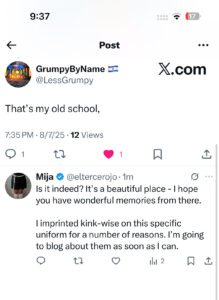
When I posted photographs, several former pupils messaged me almost immediately to identify the school. I shouldn’t have been surprised, because the uniform is distinctive. Anyone familiar with the uniform will know it, but the school itself isn’t part of this story, I’m not naming it. I don’t want to draw a present-day institution, its pupils, or its staff into my personal history of kink, memory, friendship, and the early internet.
So, I didn’t simply buy a school uniform in 2025. I finally acquired the uniform I’d wanted since 1997, when Paul and I met and online friends were still both vividly present and impossibly abstract. And my tie had crossed the Atlantic to me and then came back with me on every trip. The rest remained attached to Edinburgh, to two summers of tea at Aitken & Niven, and coffee at Elephant House. Most of all to friends who moved from screen names into ordinary life, and to the first Saint Clare story.
By the time I put it on, the uniform already held nearly thirty years of my history: the old newsgroup post, imagining Paul walking through Edinburgh, the people he might have passed without recognising, the friends we eventually met, Disneyland, MollyB, school trunks stacked around the walls, tea and cake, Whitby Abbey, and Alnwick. Maybe that’s why school uniforms matter so much. They’re intended to suppress individual difference,7 but they can become intensely personal objects, gathering meanings their designers couldn’t imagine but carrying institutional history, the imagined life of the pupil, and the private fantasies of whoever is looking at them.
Mine carries nearly thirty years of those fantasies, and, yes, wearing it feels far more exciting and secure than I could have imagined.
- Ever a rebel, she wore her uniform with cream knee socks decorated with red lions (adorable!), which were very much her own contribution rather than regulation school wear. ↩︎
- There are two ties. Most of the students wear the stripped tie. The solid tie is reserved for the prefects. ↩︎
- Note to others who love uniforms but have limited funds. School ties are very exciting and pretty inexpensive. It’s a uniform item you can buy for less than $20.
↩︎ - Okay, not impossible. But way too hard and expensive. ↩︎
- More on those later. ↩︎
- Barter Books score. ↩︎
- Something I took comfort in as a student. ↩︎
| Link | Date |
|---|---|
| About Uniforms Part 3 – A School Uniform for Mija | |
| About Uniforms Part 2: When This Schoolgirl Boards | |
| About Uniforms Part 1: Introduction – Where Did That #dailyuniform come from? | |
What rich and evocative account.
I stand, as usual, in awe of your willingness and ability to examine your innermost self and then share your findings.