2 comment(s) so far. Please add yours!
Passante asked a wonderful question in reply to “Once Upon a Time in ASSville.” They began by noting how imaginative the old ASSville/SSS community looked from the outside, then asked how the stories actually got written.1I’m replying here especially meaning stories. The “community posts” that were more collective fiction happened very quickly.
Were most people putting them all together in one sitting, or would they write them elsewhere and transcribe them into digital text?
It’s hard to get a sense for how long things took when you only have posts and timestamps, but surely everyone wasn’t just firing off these novellas over a cup of coffee, were they?
No, though I drank an awful lot of after-hours coffee. Plenty of nights I stayed up all night coaxing an idea out of my head and onto paper or screen before it could get away. The longer answer is that the timestamp lies. Not maliciously, or even with intent. On Usenet, the timestamp tells us when something was posted to the server.2Note: that’s not the same as when it appeared to readers, which could vary depending on where on the network it was injected and when it hit a particular reader’s feed. From the writer’s perspective, the timestamp is the end.
The timestamp leaves out the actual life of the story: the first notes in a journal, words whispered to a lover, drafts sent to a friend, sections added by another writer, endings rewritten three times. It can’t show the scene that had been sitting in the most secret part of the author’s imagination since they were twelve, waiting for people who might understand it.
When I opened the group, I couldn’t see any of that unless the author explained it in the foreword.3Which a lot of us did because we were wordy like that. But other people, Lurking Dragon comes to mind, never posted anything about themselves. A story could look as if it had simply arrived, but the lived rhythm was full of delay, absence, drafting, return, and rediscovery.
Writing Without Connection
1990s hardware and connectivity shaped all of this: newsreaders, dorm-room computers, work machines, shared family computers, floppy disks, Zip disks, printed stories, and the simple fact that people did not carry the internet around with them. That deserves its own post, and I’ll come back to it. For now, the important point is simpler: writing and connection were not the same thing.
In 1997, when I left my dorm room, I left the internet too. Staying in, I’d be online for hours, reading the group, answering email, writing in PINE, drafting in BBEdit, and falling down whatever rabbit holes Usenet opened that day. But when I left for class, dinner, the library, a movie, someone else’s room, or even off-campus, I was gone. Not symbolically gone. Actually gone: no notifications, no texts, no quick checking the thread from a bus stop, no glancing at comments while waiting for coffee.
Posters knew people might not read posts or email for days. Internet access wasn’t newsgroup access: someone might have a work computer but no permission to install a newsreader, or a shared family machine but no safe way to visit ASSville in private. Students, home for the summer, lost their convenient, always-on ethernet connections. Workers changed jobs and lost the accounts or computers that made reading possible. Their writing didn’t always stop. They wrote elsewhere until they could come back.
A lot of us still started everything longhand. People wrote at work, only during breaks, I’m sure. I knew someone who wrote bits of drafts in her email, sending them to herself so she could assemble them at home. Cloud storage was not a thing; moving words from one machine to another required tiny acts of logistics.
For me, writing almost always involved BBEdit, and it still does. BBEdit is a text editor that produces plain text. That mattered for Usenet. Word processors like Word or MacWrite introduced formatting weirdness: line-length problems, smart quotes, strange characters, and wrapping issues that could make posts look as if they had arrived from outer space. Yes, some people wrote in Word4Sometimes I wrote in MacWrite so I could run the spell check, but I’d save the text into BBEdit before posting. or other word processors, of course, but a lot of Usenet culture was built around simple plain text.
I carried my stories around too, though not the way I’d carry them now. I had a double-density disk with my stories on it for writing in the campus computer lab. For one brief shining moment, Zip disks felt miraculous because they could hold whole folders of drafts, versions, saved email, and bits of websites. I printed stories out too, because paper was more durable and more portable than digital text.5Years ago, when I visited a newsgroup friend, I remember thinking it was interesting but a bit gratuitous that she had printed out dozens of her stories, three-hole punched them, and kept them in a huge binder. Now many of those stories have been cleared off the ’net, while the binder is, presumably, still fine. The past occasionally has a very dry sense of humour. A printed story can still be read away from the Mac, marked up, folded into a bag, or found years later in a folder after the original file has vanished.
All of that is a long way of saying that reading and writing could be portable. Connection wasn’t.
Offline, Not Absent
People often disappeared from the internet for long stretches while remaining emotionally and imaginatively present in the community.
In the late 1990s, internet access was still uneven. Students went home for the summer, lost access to their university accounts, or found themselves sharing a family computer in a public room where visiting ASSville wasn’t exactly something one could do casually over breakfast. People travelled. Jobs changed. Moving could mean weeks without reliable access. Someone might disappear for weeks or months, then return with a post that said, in spirit: “Hi, I’m back from the summer at my parents’ house with no internet, or only the family computer, and I’ve got a notebook full of story drafts. Here’s the first one.”
The first post back could feel like opening a suitcase and finding it packed with scenes, school corridors, domestic rituals, letters, punishments, jokes, and half-finished conversations.
The author might have spent weeks writing the story in a notebook: in a bedroom where the computer was off limits, in a library, on a train, at a summer job, or during the long dull stretches when they couldn’t get online but could still imagine the readers waiting somewhere in ASSville.
Offline was not empty time. It was where the stories accumulated.
And when those stories finally did enter the public conversation, the response to them had to be made of words too.
Using Our Words
There were no “like” buttons and no quick little pellets of approval. Writers didn’t get the instant release of tossing a comment onto Bluesky, or a photo onto FetLife, and watching likes and retweets arrive.
Without likes, readers had to reply. If a story moved me and I wanted the author to know, I had to use words. Sometimes that meant three words. Sometimes it meant three paragraphs. Sometimes it meant private email. Sometimes it meant a story of my own, with a tip of the hat to the earlier author.
Replies mattered. They could pile up in ways I’d half-forgotten, and that habit followed some of us into later blogs and forums.6There’s another post to be written about how Usenet let readers control what they read, but not what other people posted. Someone might ask what happened next, remember another story, tease the writer, object, or answer with a piece of their own. The conversation didn’t merely sit politely below the story. It changed what came next.
A single question might trigger a sequel. A reader’s joke might become a scene. A conversation between readers might send the author in a new direction, or another writer might pick up the ball and answer with a story of their own.
The rhythm was not refresh-refresh-refresh. It was write, post, leave, return, discover. The reward was slower, but it could be deeper and more durable. A response could be saved, answered thoughtfully, and carried forward into the next story.
Stories Were the Group’s Currency
Here’s where the archive becomes a slightly unreliable narrator: stories weren’t merely things people posted after writing them in isolation. They did a tremendous amount of social work. Stories introduced people. They explained fantasies, sometimes more accurately than direct conversation could. They said, “This is what spanking means to me,” or “This is the sort of scene that lives in my head.” Sometimes, more nervously, they asked, “Does anyone else understand this?”
Stories were also gifts. People thanked each other with them. They flirted with them. They wrote them for friends, lovers, readers, co-conspirators, and sometimes for the wider town. A story could be an offering, a public performance, a private signal, or a way of saying, “I see what you like, and I’ve tried to write toward it.” They even occasionally ended flamewars, but that’s another post.
The newsgroup offered something we’d never had before: readers who understood why these stories mattered. Not just readers who consumed them silently, but readers who answered, asked questions, teased, recognized something of themselves, and sometimes wrote back.
Most of us arrived carrying stories we’d never dared to tell. That’s why the newsgroup mattered so, and why it was loved. Not files, necessarily, though sometimes those too, but years of scenes, images, phrases, rituals, and half-imagined stories with nowhere to go. The newsgroup didn’t create those fantasies out of nothing. It gave them language, audience, response, and a place to circulate.
Stories were also part of romance, in the broadest sense. Not always romance as love, courtship, or coupledom, though sometimes absolutely that too. People wrote stories as a way of telling their own kink, and as a way of fantasizing with other people. A story could be self-portrait, invitation, gift, flirtation, theory, and scene negotiation all at once.
In a spanking community, “what are you into?” was not always answered best by a list of implements or roles. Often the truest answer was a story. A story could say how you wanted to feel.
That was part of the thrill and part of the danger. In response, someone might rewrite the scene, or write a new one, with their own fantasies dancing tango with the other author’s.
That kind of writing could be tender, erotic, funny, intense, generous, messy, and sometimes more intimate than anyone had expected when they started typing.
So when people ask how the group produced so much writing, part of the answer is that writing wasn’t only something people did alone. Stories were how we told ourselves to others. They circulated. They carried recognition, desire, apology, gratitude, argument, and play.
They were the coin of the realm.
As to Firing Off Novellas Over Coffee…
Sometimes, a short (or not so short) piece really did come quickly. A joke, a roleplay response, a parody, a bit of public mischief, or a short fantasy might be written in one sitting. Some community posts were absolutely the product of a mood, a thread, a few friends, and a burst of collective nonsense.
But many stories were not sudden at all.
They had been drafted offline, revised in plain text, carried on disks, printed out, written longhand, emailed to friends, answered by readers, continued in private, and returned to the group days or weeks later. They had been living in notebooks, journals, inboxes, saved files, printed pages, and people’s heads.
The old posts and timestamps can make the process look faster than it was. They show the moment the writer let the story go. They don’t show the quiet work of getting it there.
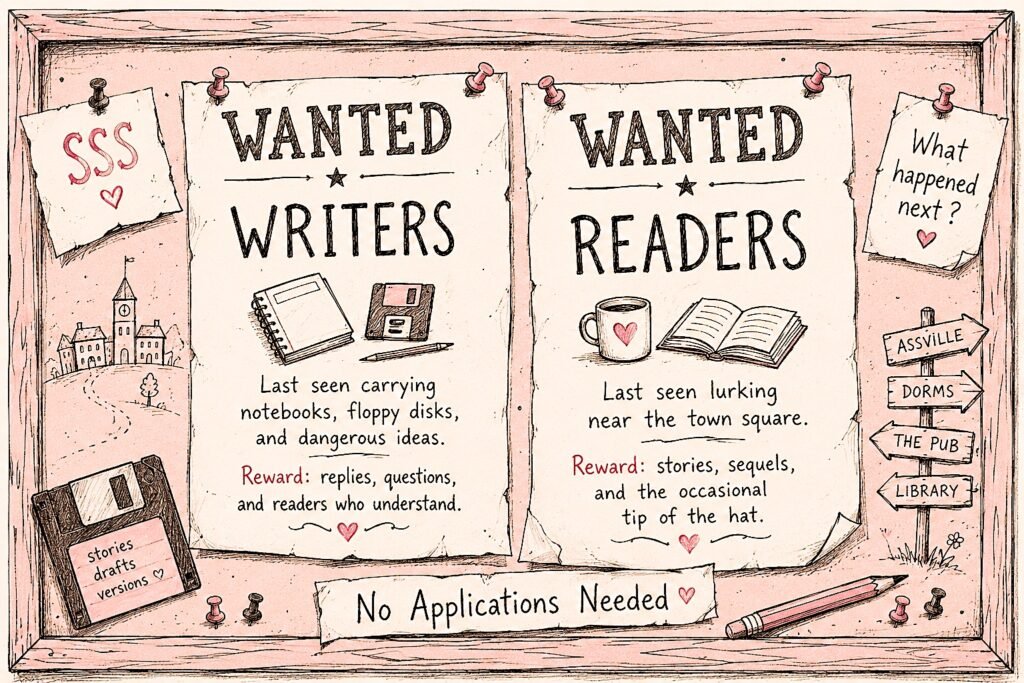
No, we weren’t all firing off novellas over a cup of coffee. But sometimes, after years of thinking we were the only ones with these stories in our heads, it turned out a cup of coffee, a blinking cursor, a notebook, a floppy disk, a printer, and a waiting town could go surprisingly far.
Writers need readers. And we had a town full of them.
Welcome to Assville.
- 1I’m replying here especially meaning stories. The “community posts” that were more collective fiction happened very quickly. ↩︎
- 2Note: that’s not the same as when it appeared to readers, which could vary depending on where on the network it was injected and when it hit a particular reader’s feed. ↩︎
- 3Which a lot of us did because we were wordy like that. But other people, Lurking Dragon comes to mind, never posted anything about themselves. ↩︎
- 4Sometimes I wrote in MacWrite so I could run the spell check, but I’d save the text into BBEdit before posting. ↩︎
- 5Years ago, when I visited a newsgroup friend, I remember thinking it was interesting but a bit gratuitous that she had printed out dozens of her stories, three-hole punched them, and kept them in a huge binder. Now many of those stories have been cleared off the ’net, while the binder is, presumably, still fine. The past occasionally has a very dry sense of humour. ↩︎
- 6There’s another post to be written about how Usenet let readers control what they read, but not what other people posted. ↩︎
This certainly does put things into context. The idea of a floppy disk full of stories makes me nervous just reading about it, let alone inserting the disk into a lab computer! Though I suppose there was less [healthy?] paranoia back then? Less paranoia, more stories, more space to breathe. (but, of course, not a complete disregard for privacy and anonymity)
I think you are right that stories are particularly important to *gestures vaguely*. Every group has its stories (about itself, if nothing else), but there is something particular to this one that makes context and internal monologue so important. There are a few easy guesses as to what, but that would be your area of expertise, not mine.
Thank you so much! And yes, probably, at least in my case, way less paranoid than I should have been. Privacy and anonymity mattered enormously, but the tools, habits, and imagined risks were *so* different. A disk (or flash drive) full of stories might sound terrifying now, but in 1999 it felt practical, portable, and reassuringly physical. The stories existed somewhere I could hold onto, rather than in a cloud account (those weren’t available even in small quantities until 2008 when Dropbox started), a platform database, or whatever service might daily change its terms of use.
I didn’t/couldn’t imagine what was coming: huge aggregations of data, harvested and made instantly searchable, sometimes decades later. The scale of change is still mind-blowing. Unless I ran for public office, it once seemed impossible anyone could or would go to all that trouble. I thought the few posters preaching caution were too paranoid (Barrister comes to mind as someone deserving a Cassandra Award) but in retrospect most of us were less cautious than was wise. Yet, I confess I’m glad I didn’t see what was coming. I’m not sure I’d have been as honest or open if I’d been able to see thirty years down the road.
Yes, I may be biased, but I think that stories mattered in this community in a particularly intense way. Spanking stories often did more than entertain. They explained what happened, why it mattered, what it felt like, what someone wanted to feel, and/or how internal negotiations worked. So much of kink lives in context, anticipation, permission, shame, recognition, and afterthought. A bare description of action misses most of that. They were so frequently the catalysts of larger discussions. They also, as I said, were a way of repairing and healing after intense disagreements. That part’s more important than I can say.
Which is a long way of saying: yes, this is very much one of the strange little rooms in my area of expertise. And your questions are helping me find the doors.