3 comment(s) so far. Please add yours!
Introduction
 The papers gathered here belong to the wider Saint Clare archive and sit alongside the documents already familiar to readers of the Inez de Vries sequence: detention essays, staff memoranda, prefect minutes, household logs, and the private writings that have a habit of surviving precisely because no one quite knows what to do with them.
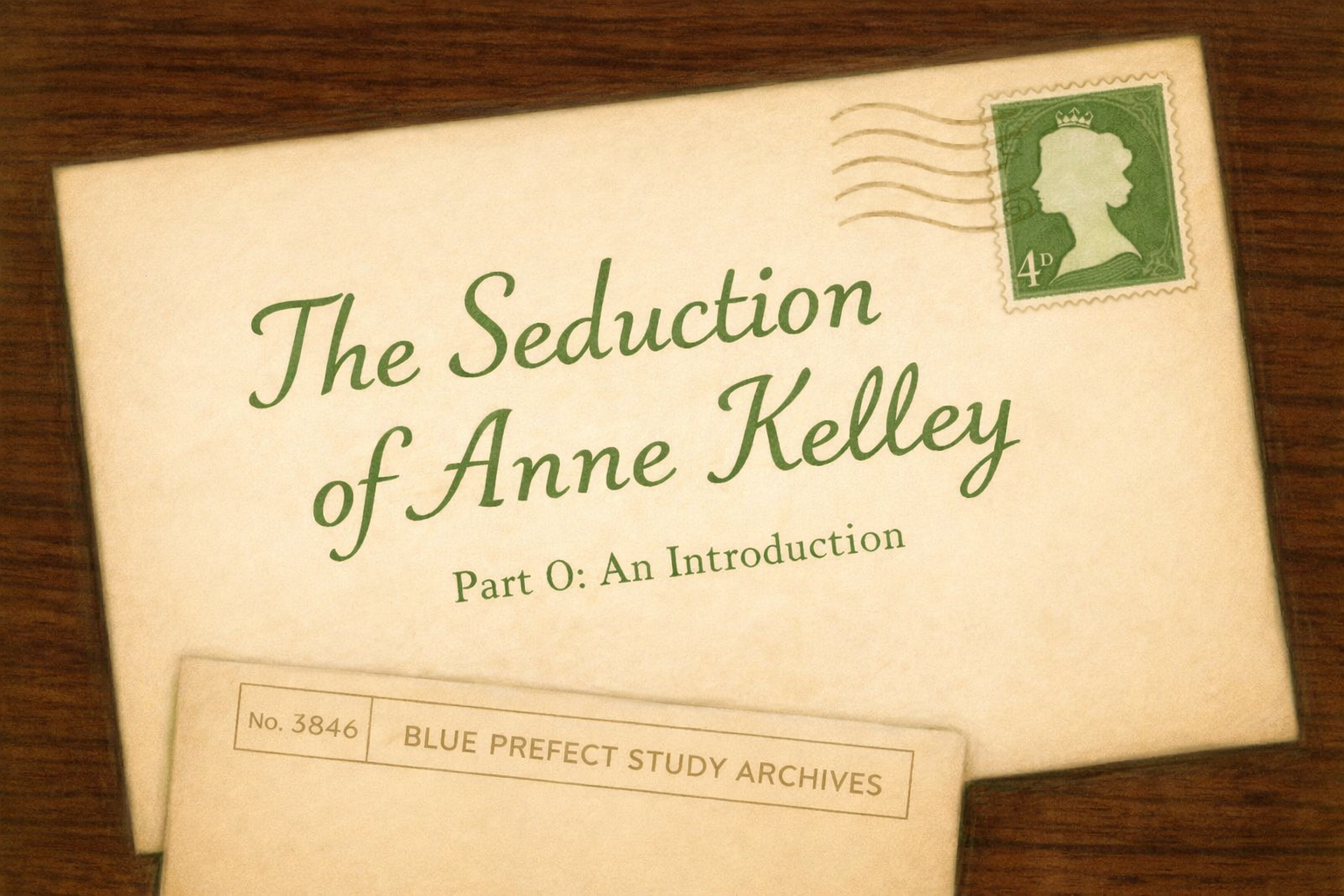
The Seduction of Anne Kelley draws from the Kelley–de Vries correspondence, preserved in the Blue Prefect Study papers, where material that is neither wholly private nor entirely official has long been kept. You will find letters meant to be burned, copies retained “for reference,” and drafts that should by rights have been torn up but were instead saved, retied, and filed under headings of optimistic vagueness. Some pages are neatly typed, as though the truth might be made more palatable by proper margins. Others arrive in the swift, unsteady cursive of someone writing under pressure, or in a place she very much ought not to be.
The sequence opens, deliberately, near the middle of things. In July 1955, Anne Kelley, a Saint Clare’s English mistress, writes a letter to “Gwennie” with the ease of long practice. Only afterward do we return to the beginning, to see how their correspondence formed, why it was encouraged, and what it made possible.
Readers are invited to take up the archivist’s task, and the investigator’s pleasure, of weighing what people say they intended against what they were, in fact, doing. Much will be implied. Little will be stated outright. Those accustomed to the School’s “special friendships” may notice familiar patterns resurfacing in adult form: the same hierarchies, the same alliances and intimacies, and stakes rather higher than dormitory gossip ever required.
These letters trace the development of that correspondence, from proper parental enquiry to something more deliberate, conducted quietly over time in the familiar idiom of the School. For those who prefer their archives with a guide, a brief introduction to the principal actors has been provided, in the manner of a proper dramatis personae. The archive remembers. And so, of course, does Inez.
Comments are warmly welcomed. While I enjoy seeing them on Bluesky and Twitter, those left here become part of the archive proper, where they may quietly shape what follows. I cannot promise the archive is obedient, but it is, as ever, attentive.
Archivist’s Foreword
This document, a letter from Anne Kelley, English teacher and housemistress for Inez and Clarissa, is written on Saint Clare’s letterhead and dated 12 July 1955. The reader will recall that 12 July 1955 was the day of MP Gerald Charrington’s visit, the sort of day the timetable insists is perfectly ordinary right up to the moment it becomes legendary, and when poor Clarissa learned that a man may promise to “conclude matters at home” while concluding them perfectly well in the Headmaster’s study. Despite the letterhead, this document is not a school report. It is not, in fact, an official communication at all. It is, strictly speaking, the sort of thing the writer hopes will be burned, mislaid, or eaten by the dog before anyone has the bright idea of filing it.
Fortunately for this archivist, and for you, dear reader, it was saved and filed.
The reader may recall that earlier, in Miss Kelley’s own journal, there is a line about “enough of this ink-spilling” and the need to “take up a clean sheet” in order to write to “Gwennie” about the day’s events.[1] This is that clean sheet, or at least one of them. Saint Clare’s, as we are learning, produces duplicates with the same ease it produces contradictory rules.
The letter was later found among Lady Gwendolyn’s papers in the Blue Prefect Study archives, as part of a bundle tied with green ribbon and optimistically labelled “Williams, G., Misc. 1955.” It is marked, in spirit, for your eyes only, which in any archive, even Saint Clare’s, is less a boundary than an invitation.
[1] One further note, offered as an observation rather than judgement: the salutation of “Gwennie” is not the sort a young schoolmistress generally addresses to either a countess or the mother of a pupil. And yet Anne Kelley is generally so very professional and proper. Curious, that.
Saint Clare’s School for Girls
12 July 1955
My dear Gwennie,
You asked to be told when anything material touches Clarissa; what follows is for your eyes only. I was correcting essays at the outer desk by the Head’s study when Mr. Charrington arrived with Miss Gladys Williams. I will not pretend I did not linger. One can hear perfectly well from that chair if one is so inclined.
Gladys owned, in her truculent, defiant fashion, that she had slipped part of Clarissa’s letter into her own post so that it should reach you. Mr. Charrington pressed her to state the facts plainly (“from Inez to Lady de Vries”), which she did, though sulkily. The Head, much relieved to have the “mystery” solved, affected dignity and then fled into small talk and sandwiches while a girl was sent to fetch Clarissa.
There followed an awkward quarter-hour of weather, gardens, and the fête. I could hear the Head making host noises, and Mr. Charrington answering with that steady, clubman composure that does not trouble itself to rise for small inconveniences. Gladys said little, or nothing. Silence can be as expressive as speech when one is trapped in a room with adults.
When Clarissa was brought in and the door shut, Mr. Charrington took her through the same catechism he had exacted from Miss Williams: what she had done, what she ought to have done instead. Clarissa stumbled, then steadied; notably, she would not name Inez. When she could be led no farther, he supplied the rest himself and then, speaking first with real affection, then with authority, administered a paternal correction there and then. It was not savage, but it was inexorable; the sounds leave no doubt on that point. He told her the school was to hear no more of this, and that the matter would be concluded at home. When they emerged, she was tearful but contained; I sent her to Matron with a note and followed shortly to explain.
Before all this I took the trouble to read through Gladys’s file. It is one of the fattest in the cabinet (telegrams, letters, memoranda, marginalia in every hand), and yet not a single slip for lines, not a single record of detention or corporal punishment. Always tragedy, always indulgence, never consequence. She is, still, exactly as the early entries describe: lovely, spoilt, and unsteady, grown into her beauty but not into ballast. Mr. Charrington, meanwhile, was already the Member he is soon to be: correct, certain, and entirely blind to the patterns under his nose.
Inez will learn from this; she has the grit for it. Clarissa has learned something sooner than most, per disciplinam et lacrimas, ad astra, and will, I think, be the better for it. As for Gladys, I doubt she has learned anything at all.
Burn this, or lock it away with the others.
Yours Sincerely,
Anne Kelley
Afterword
“Burn this, or lock it away with the others.” Readers may take their time over that final phrase. It is one thing to lock away a single indiscretion. It is quite another to have a place prepared for it.
The letter is frank, even brisk, right up to the point where Miss Kelley instructs it to be destroyed. Saint Clare’s produces many fine traditions, but none so durable as the habit of saying one will destroy a thing and then saving it carefully for later. That instruction does not, as it happens, appear to have been followed.
What matters, for our purposes, is not simply that Miss Kelley wrote to Lady Gwendolyn, but that she wrote to her as “Gwennie,” and did so without hesitation. One does not usually arrive at such ease in a single afternoon.
The papers that follow were kept together, tied, retied, and ultimately filed under “Private.” They are dated, to the reader’s possible astonishment, 1947–1968. Do not panic. We are not reading all of it today
Do not panic.
The sequence resumes, in earnest, with Part 1: Old Girls, New Channels.
So listen: Not to make a hobby horse of this Gladys business, and even at the risk of you suggesting I’m a bit obsessed about the girl, but . . .
Here now is Miss Kelley (presumably without prejudice or self-interest to serve) describing Gladys as variously truculent, defiant, sulky, and spoilt. (A veritable thesaurus being necessary to describe this young woman’s ill tempered mien.) Then she notes that despite a file bursting with misbehavior, Gladys never faced a single consequence at St. Clare’s. Not a detention, nor lines, much less a spanking at the time clear and loving boundaries would have done her the most good. Here is poor, loyal, brave Clarissa learning that per disciplinam et lacrimas, ad astra, and even Miss Kelley notes that Gladys (let us say “poor Gladys” as well) has learned nothing at all.
Feeling for the tragedy she suffered, one still cannot help but notice that the tragedy—thanks to the misguided solicitousness of those who had her in their charge at the time—is now echoing out in terribly unfortunate ways.
As for Miss Kelley, her writings reveal what I learned in 15 years as a reporter and have confirmed in 30 years as a lawyer: the staff always sees everything. And yes, especially in the time and place and society she inhabits, Miss Kelley’s use of “Gwennie” (indeed, “My dear Gwennie”) is a meaningful signifier indeed.
You’re not making a hobby horse of it. You’re being a good “faithful reader”! If anything, Miss Kelley is the one building a “Gladys Thesaurus” suggesting the girl really did have a gift for varied sulk expression. (Is “sulk expression” a thing? Dunno.)
And yes, the thing that lands isn’t only “Gladys is SO difficult,” it’s that her school file is (apparently) enormous and yet… nothing ever happens. No lines, no detentions, no sharp, early consequence at the point where it might have helped her most. Saint Clare’s can be very… *brisk* in terms of its discipline when it chooses to be. That the school never quite chose to be, in Gladys’s case, feels like a decision in itself (why? … stay tuned!), and you’re right that the original tragedy gets to echo outward in all the wrong ways.
Meanwhile poor Clarissa gets the full *per disciplinam et lacrimas, ad astra* experience, and is, one hopes, learning fast. Here, Miss Kelley’s “Gladys has learned nothing at all” is telling because it’s *not* written as a zinger. It’s written as a weary, exact conclusion.
Also, your reporter/lawyer line made me laugh because it’s painfully true. Staff always sees everything. Even when they pretend not to. Especially then. Which is why that “My dear Gwennie” matters. In that world, from that woman, to the other, you don’t write like that by accident. It’s not just a signifier, it’s verbal raised eyebrow.
What a marked difference between Miss Kelley’s journal and her private correspondence with Lady DeVries! It seems she trusts her letters to “Gwennie” will never see the light of day, whereas perhaps she seems a bit more circumspect and matter-of-fact with her diary entry. I wonder how Miss Kelley came to be so trustful of Lady DeVries; no doubt this single letter is the iceberg visible above the waterline and a great deal more lies beneath, waiting to be discovered.
I do wonder what game Lady DeVries is playing at, wanting to be informed about Clarissa’s welfare. Perhaps it relates to her part in the letter smuggling caper, or perhaps there is something much larger happening here. Or maybe there is some concerted effort involving Gladys that is the ultimate aim of Lady DeVries, and Miss Kelley seems to be a willing co-conspirator, given her snooping into the files.
I wonder also whether Miss Kelley’s conclusion that “Gladys has learned nothing at all” is less of a statement of weariness and more a reflection of dashed hopes – I can imagine that Miss Kelley might harbor a fervent wish to see Gladys finally be called to account after seemingly getting off scot free for so many years. After all, she certainly seems to tacitly approve of MP Charrington’s treatment of Clarissa.