6 comment(s) so far. Please add yours!
Hello. Is this on? Can you hear me in the back?
Okay. Well. Let’s do this.
Most of my adult life I’ve kept my scholarly self and my kink/schoolgirl self in separate binders, carefully labeled, alphabetized, each with dividers organized by topic. Recently I’ve tentatively slipped into the same ring mechanism, as seen in my ever-so-long November 2025 post, The Music of Discipline: Notes Toward a Sonic Saint Clare.
This post, is an attempt to think seriously, historically, and affectionately about the early online spanking community that shaped so much of my intellectual and emotional life in the late 1990s. It is also the beginning of a larger project about Usenet, digital culture, communal governance, archives, and the textual world many of us once called “ASSville.”
Note:
A caveat: Human memory is a notoriously unreliable archive. The ASSville I describe in these essays is necessarily partial, shaped by my own experiences, friendships, conflicts, blind spots, and affections. My “golden years”1The term “golden years” refers to the newbie energy people tend to have when they first came on the group. Whenever it was, it was, in their memories, always the group’s *best* time. on the group were roughly 1996 through 1998. Other residents arrived earlier, came after, occupied different social circles, and likely will remember events differently.
I hope they will tell me about it, here or elsewhere.
One of my goals for this series of posts is not sharing and preserving my memories –that’s what The Treehouse is for– but to begin a conversation about our shared past or pasts. If you were there and remember things differently, if I’ve gotten details wrong, overlooked important people or events, or misunderstood something, please leave a comment. Likwise, share what you remember if it’s similar too. The history of ASSville, like ASSville itself, was collectively made. Perhaps the remembering it can be collective as well. Of course, if you weren’t there and have questions, please ask them.
Another note:
Memory presents other complications as well. Example? Between May and the end of August 1997, I had no internet access whatsoever. No Usenet. No email. Nothing.
In our “Always On” world this is almost unimaginable.2See my account of the uncanny experience of being offline for only a few weeks last summer (2025) In 1997 it was inconvenient and not unusual. Still, for nearly four months I disappeared entirely from ASSville. I could neither read nor post, send nor receive email, lurk nor participate. The only news I received about the group came second-hand through (almost) nightly3These calls required me to find a phone where he could call me. At times, that meant sitting in front of a pay phone at midnight. No, it wasn’t snowing. telephone conversations with Paul.
There are, therefore, entire stretches of ASSville history that I experienced only through retelling, summary, gossip, and memory. Even at the time, my understanding of events was partial and mediated. I barely understood how the technology worked. Magic, as it happened.
This is worth remembering because no one person, however active, ever experienced the whole of ASSville. We each inhabited particular neighborhoods, friendships, arguments, and moments. The town we remember is and was therefore always both real and incomplete.
Los Angeles, late Fall 1996, the top floor of a small four-plex on Mariposa Avenue.
I was in the first semester of my PhD program, learning how to live alone for the first time and trying to find my place in a city that was home but also new. On my desk sat a beige Mac Performa, the sort that purred more than it processed. Through PINE (a UNIX email platform) I dialed into my university to check my email one line at a time, black text against a soft brown-grey screen. Late one evening, almost by accident, I wandered beyond my inbox and into something called Usenet.
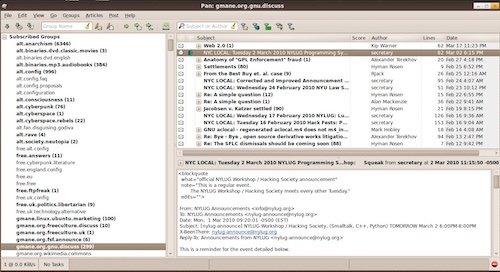
At the time, I understood almost nothing about internet architecture. I only knew that suddenly there were lists upon lists of discussion groups, arranged into sprawling categories that seemed to contain all human thought, or at least all human obsession. Some were political. Some technical. Some scholarly. Some were devoted entirely to television shows, recipes, obscure bands, or cats. Others seemed to exist solely because somewhere, sometime, two people wanted to keep talking to each other. Many were abandoned or even jokes.
Opening one felt less like entering a chatroom (an experience still a year or so away for me) than wandering into an infinite, specialized library being built collectively in real time. Each group was a bulletin board made of ongoing threaded discussions that accumulated over days, weeks, and months. People argued, flirted, debated, confessed, theorized, and told stories. Every active group developed its own customs, tone, and emotional weather.
Somewhere within that branching map, I found alt.sex.spanking.4This happened after reading alt.sex.personals.spanking for several nights running and then clicking on a crossposted groupWhat I found there wasn’t simply reading material on my favorite erotic subject, although there was plenty of that. The most startling find? Recognition. Desire too, yes, but also language, humor, argument, storytelling, and the astonishing realization that I wasn’t alone. Moreover, it was clear that a lot of these people knew each other, were friends.
Until then, the fantasies about spanking I’d had as far back as I remembered existed in private.5Telling my then-husband had been a disaster. These posts belonged in the same hidden internal world as my fantasies, diary entries, and the many unfinished stories tucked into old notebooks as things intensely imagined but never spoken aloud. I’d looked up the same words6So many words – especially the “s” word and all its many synonyms. in dictionaries, encyclopedias, and academic journals7 Some of us joked that our academic formation started with research looking for the word “spanking” and its synonyms everywhere possible. without ever imagining I might someday encounter other people, living communities using them casually in conversation.
And suddenly there in my Mac, in my quiet apartment was alt.sex.spanking, ASSville, alive, a community growing as I read.
People there discussed spanking not simply as fantasy, but as culture, sexuality, identity, narrative, memory, humor, and craft. The 1995 FAQ described the group as unusually friendly and proudly high in “signal-to-noise ratio,” language that now feels both charmingly retro-technical and deeply communal. The goal wasn’t agreement so much as coexistence and, perhaps, understanding and empathy.
ASSville’s residents argued about ethics and spoke of early experiences. They wrote stories, reviewed parties, and co-wrote scene reports. They developed reputations, running jokes and communal histories. Flirted badly and formed friendships. Broke each other’s hearts. When I entered through my screen I felt like Alice. What I’d thought were fantasies I held in solitude revealed themselves instead as part of a chorus.
Until then, I’d never used a computer for connection beyond my university email. My Mac was a glorified typewriter, a place for drafts, footnotes, and panicked essay writing.8Also 100 pages of a historical romance novel ironically called “Abandoned Dreams.” But now, as posts accumulated and my eyes hoovered them, I could feel a different kind of literacy forming, one built not simply on argument but on attention and participation.
My memories are undoubtedly rose-colored, especially for this period. I know alt.sex.spanking was imperfect, sometimes dramatically so. There were flame wars, trolls, misunderstandings, long silences, personality conflicts, and occasional eruptions of astonishing stupidity and cruelty. In other words, it was populated by humans.
But beneath the noise was something remarkable.
The group held itself together not via formal authority (none was possible) but by a communally written FAQ and interconnection. Like other Usenet FAQs, the one for alt.sex.spanking explained terminology, expectations, etiquette, boundaries, and norms of behavior. It wasn’t law nor even rules. Nobody could force compliance. The group operated more through collective disapproval than censorship, through censuring rather than censoring. Looking back now though, what fascinates me is how much labor and care went into constructing those shared norms. Years before formal moderation existed, people were building systems that balanced freedom with responsibility, arguably because there was no moderation, because no one was in charge.
The FAQ itself ran more than 7,000 words and listed multiple contributors. The discussions that shaped it were ongoing and happened publicly on the group itself through argument, revision, negotiation, and collective reflection. They also happened in private between friends. The community was actively writing and rewriting the terms of its own coexistence.
At the time I didn’t yet have language like “digital governance” or “affective labor.” I only knew that reading the FAQ felt strangely familiar. I recognized in it something I already understood and researched in courses about feminist and communal spaces. There was an ethics of care articulated collectively and maintained through participation and social agreements.
For months, as was considered good practice,9And also because I was SO CONFUSED. I remained entirely silent, lurking in the original sense of the word. On Usenet, lurkers were invisible unless and until they chose to speak. There were no visible follower counts, usernames, avatars, or presence indicators. No means of monetization.10Though I guess someone somewhere must have fallen for SPAM and its inevitable penis enlargement promises… To lurk meant simply to read, to observe without announcing yourself. Since once a Usenet post of any sort went out there was no way to either edit or delete it, posting anything, especially for the first time, was a huge deal.
The alt.sex.spanking FAQ encouraged newcomers to “delurk” with introductions that included stories, histories, tastes, and reflections, treating participation less like profile creation and more like entry into an ongoing communal conversation.
Eventually I wanted to post. I reached out privately by email to “Bea,” a woman whose posts struck me as warm, funny, and welcoming. She wrote back. Then, still in private correspondence and with my agreement, she contacted another member on my behalf, someone with more technical knowledge, to help me figure out how to post to the group without exposing my legal name and university email address. Free webmail accounts were still novel enough then to feel faintly miraculous.
What followed wasn’t one dramatic leap into visibility but a careful, staged process. Instructions were exchanged, including discussion of a strange new free email platform called Hotmail.com. Precautions were taken and tested. Technical mysteries were solved one step at a time.
Only then did I finally make my first public post in early 1997.
That was how “Mija” came into being, a name selected by the sweet poster who initially helped me.
When I look back now at that younger version of me sitting at her keyboard late at night, newly named and newly tentative, I feel enormous affection and tenderness toward her. She was exhausted, lonely, curious, intellectually hungry, and profoundly unsure of her place in the world, but still brave enough to hope.
She was also doing something historically familiar, something I knew about because it’s part of what I research (then and now). Like many women before me, I was joining a textual community. I think that may be one reason the space felt immediately legible to me despite Usenet’s technical unfamiliarity. The Chicana feminist writers and editors I studied and researched as an undergraduate and graduate student, (and still do) also built their networks through writing: newspaper, mimeographed journals, collaborative anthologies, newsletters, ‘zines, letters passed hand to hand and city to city. Different technologies, but recognizably similar forms of labor. What I encountered on Usenet was that same communal impulse rendered in code.
People like me often speak nostalgically about the “old internet,” usually meaning the internet before platforms consolidated power, tracked clicks across platforms, and monetized identity. Some of that nostalgia is misplaced. Early online life could be cruel, exclusionary, chaotic, and naïve. Whatever else it was, however, it was important. Formative.
That’s one reason for writing these posts now.
Another related and more ambitious one is to try and find a way to research and write about newsgroups more generally. Given its importance, there’s still little written about the history and significance of Usenet. I believe that’s because Usenet itself isimpossibly large. At its height, it contained thousands of active newsgroups devoted to every imaginable topic generating vast quantities of text, thousands upon thousands of posts. No single scholar can hope to get their arms around”Usenet” as a whole.
The Usenet archiving situation only complicates matters. Although services such as Deja News (later Google Groups) created the impression that Usenet had been comprehensively preserved, the historical record is uneven and incomplete. Many posts have been lost. Others survive only in fragmentary form. Accessing older material can itself require considerable technical expertise.
Communities like ASS face additional challenges because they existed within the anarchic alt.* hierarchy. Unlike the more formal “Big Eight” newsgroups, alt.* groups weren’t uniformly carried by all servers. Many institutions and internet providers chose not to carry them at all, or only carried selected portions of the hierarchy. By the late 1990s, increasing storage costs, spam, binaries, and concerns over sexually explicit material led many providers to reduce or eliminate their alt.sex* feeds altogether.
As a result, much of the history of early online sexual communities has simply disappeared.
The irony is difficult to miss. Communities that depended on Usenet to overcome isolation and stigma may be among the least well preserved in the historical record.
I can’t fix that, nor am I trying to do so. What I’m posting here is neither a comprehensive history of Usenet nor a definitive history of ASSville. Instead, it’s a series of notes from one former resident of a very particular town, reflecting on what life there might tell us about community, technology, desire, and the early internet.
For all ASS and SSS’s faults and flaws, something genuine and valuable existed there. For decades.
These communities weren’t built for visibility or branding or commerce. They emerged because people needed spaces to think together, desire together, argue together, and sometimes simply keep each other company through the long loneliness of being, especially of being unusual.
In late 1997 alt.sex.spanking became the first alt.sex.* group to migrate into a moderated hierarchy, soc.sexuality.spanking.11This was a huge deal, involving months of discussion, work, and a Usenet-wide vote. The move was a response to the increasing flood of spam and binaries overwhelming Usenet. Moderation had to become a technical infrastructure rather than purely social negotiation. Yet even then, the foundations remained communal and ethical before they became procedural.
Looking back now as a scholar of digital and print text cultures, I realize how much those years shaped me intellectually.
I learned how to read text closely in emotionally charged environments. To understand that sometimes people had to post rants before they could discuss anything. I learned how communities negotiate conflict and language creates belonging. I learned that infrastructure can never be neutral — someone must always perform the labor of maintenance. That labor becomes or at least is perceived as unequal power. Through it all, I learned that care itself can be a technical practice, that social problems can’t be solved by technology. Those lessons stayed with me long after the communities I was part of disappeared.
And disappear they largely did.
Usenet still technically exists; however, much of its earlier history is lost, fragmented, privatized, or rendered inaccessible. Entire emotional worlds vanished along with old servers and neglected archives. Communities that once felt enormous now survive mostly in memory, scattered text files, partial captures, web archives, and the stories former participants tell each other. Even the group’s oft-cited FAQ now survives only precariously through scattered archives, aging mirrors, and websites modern browsers flag as “not secure.”12That need for stability and preservation is one reason I added the 1995 version to the Mija’s Room site.
Lately I’ve wanted to document the bits of that history that I can, partly out of intellectual curiosity and, ultimately, out of gratitude.
The result is a new project, still in proposal form, currently titled Hearts in the Machine: Love, Usenet, and the Digital Commons. Part digital ethnography, part archival recovery, and part memoir, the project explores how early online communities attempted to build systems of governance, care, intimacy, and collective responsibility before the rise of platform capitalism and influencer monetization reshaped the internet around visibility, commerce, and extraction. At its center is a question that feels increasingly urgent: what can these early experiments in communal digital life, citizenship, and governance teach us now?
These spaces were decidedly not utopias and that’s not a bad thing. All utopian projects eventually fracture under the weight of human contradiction, the paradox of generosity and selfishness. Still, as communities the groups mattered and left traces that are still visible. Bits of code. Stories. Names. Arguments. Words. Charters. Websites. Friendships. Forms of care improvised collectively by people who often had very little institutional protection elsewhere, people freely gave hours, days, months, and years of themselves to maintain them.
In some ways, this project is an attempt to build an archive of gratitude, to thank the strangers who taught me how to think about consent, community, storytelling, governance, and love not only as emotional experiences, but also as collaborative structures people build with and for each other. It’s also a reminder that behind every interface, every network, and every machine, there are human hearts: hopeful, imperfect, imaginative, and still trying to make worlds where more of us can live.
Note: Another goal is for none of these posts to be more than 3000 words. We’ll see how that goes
- 1The term “golden years” refers to the newbie energy people tend to have when they first came on the group. Whenever it was, it was, in their memories, always the group’s *best* time. ↩︎
- 2See my account of the uncanny experience of being offline for only a few weeks last summer (2025) ↩︎
- 3These calls required me to find a phone where he could call me. At times, that meant sitting in front of a pay phone at midnight. No, it wasn’t snowing. ↩︎
- 4This happened after reading alt.sex.personals.spanking for several nights running and then clicking on a crossposted group ↩︎
- 5Telling my then-husband had been a disaster. ↩︎
- 6So many words – especially the “s” word and all its many synonyms. ↩︎
- 7Some of us joked that our academic formation started with research looking for the word “spanking” and its synonyms everywhere possible. ↩︎
- 8Also 100 pages of a historical romance novel ironically called “Abandoned Dreams.” ↩︎
- 9And also because I was SO CONFUSED. ↩︎
- 10Though I guess someone somewhere must have fallen for SPAM and its inevitable penis enlargement promises… ↩︎
- 11This was a huge deal, involving months of discussion, work, and a Usenet-wide vote. ↩︎
- 12That need for stability and preservation is one reason I added the 1995 version to the Mija’s Room site. ↩︎
This was a fascinating read.
My lovely bride and I came at the group from a different perspective than most, I think. We were five or so years into our marriage which — as I’ve written about elsewhere – was utterly monogamous and centered on a then-evolving light-hearted (but very earnest) domestic discipline dynamic. We were doing this more or less with no context or resources, just sorting out what we liked and didn’t, what worked and didn’t. By 1996, I won’t say we had it figured out, but we certainly had in place a lot of practices and perspectives that persist today on the eve of our 35th anniversary.
So for us, the group was decidedly NOT a means to seek real world connection. Our interest in and practice of domestic discipline and spanking has never been something we’ve wanted to share with others IRL. (We have probably made TOO much of this desire for privacy, but it is what it is.) Instead, the usegroup was a place to explore and listen to others – all of whom seemed to us far more “scene savvy” than we were – talk about TTWD. It was a place to experience the scene vicariously. (Just because we weren’t going to GO to Shadowlane party, that didn’t mean the whole notion didn’t seem scintillatingly hot and intriguing to us). It was also, to be frank, a free and abundant source of some really excellent story-writing. Spanking erotica via text was always, for both of us, key to the part of TTWD that is “kink,” as opposed to the larger part of it that is just how we live our lives. The stories in those early days were many and often excellent. We followed your postings and those of some other “stars” very eagerly. (The stories from you and Pablo, along with a few others, fueled more than a few cozy evenings in our home.)
We were almost exclusively lurkers (commenting mostly to praise a story we liked), to the point where we got to feel a bit guilty about that and eventually contributed a couple of stories that reflected (fun house mirror-wise) our own dynamic. (I’d give a lot to be able to find copies of “Executive Privilege” and “It’s My Party,” but I think they are lost to the ether.)
But when, eventually, we DID engage on a more one-to-one level with folks on the group, that turned out to be a bit problematic. I found I had a tendency to top-flirt (is that a word?) to a degree I would NEVER flirt with anyone IRL, and I didn’t like it in me. I have been 100% faithful through nearly 35 years of marriage and I felt like my own behavior sometimes was edging the line. That’s silly in a way – these were electrons and pseudonyms. But, as I say, I did not like it me. As for MLB, she found out quickly that the least personal opening was immediately read by many tops as invitation. Somewhere around 1998 or so (I think. Time blurs.) we pulled the plug.
I think that your idea for an academic look at these virtual spaces is a very good one. So much of our interaction with others now is online that we don’t think of the MEANS at all. For all the evil social media may do. building and maintaining connection across time and distance is one of the true benefits of social media. (My high school alumni page means that old friends now scattered across the globe can be in each others’ lives. MLB has girlhood friends on every continent of Antarctica and is up to date on all their lives.) ASSville and the other usenet groups as proto-social-media seems to me worth study.
Thank’s so much for writing this. This is exactly the kind of different-but-overlapping memory I was hoping people would share.
I especially appreciate you stating explicitly that ASSville wasn’t necessarily a path toward meeting people in person — something I completely agree with, ironically for myself too . When I first started reading, and even when I first started posting, I had no intention of meeting anyone from the group in real life ever – couldn’t even have imagined it. Posting, let alone emailing was thrilling. The astonishing thing was much more basic than that for me: my excitement and the draw of the group was that there were other humans who thought about this. They had language for it. They had jokes, arguments, ethics, stories, opinions, histories. They were real people, somewhere out there, typing about things I had thought were mine alone.
That alone was unbelievable. And yes, the stories absolutely mattered as a form of connection. Reading them, writing them, recognizing something in them, carrying them back into one’s own private life — that wasn’t lesser than in-person community. For some people, perhaps many people, that textual, vicarious, erotic, and imaginative connection was the main thing, or even the whole thing. For me, writing stories with and for people was far more rewarding and, well, for lack of a better word, intimate (not in a sexual or romantic sense, but in the sense of sharing) than having coffee with them was.
I also think “top-flirt” is a brilliant coinage, right up there with bookbabe’s “spankosexual.” It’s funny, but it also names something real. Usenet maybe felt distant and safe because it was “only” text, “only” electrons, “only” pseudonyms. Then, sometimes rather suddenly, one realized the communication shared deeply held emotions, fantasies. Maybe especially because of the shared kink, and because so many of us had spent years thinking we were alone with it, the intimacy could become powerful very quickly.
That didn’t make it unreal. If anything, the distance sometimes made it easier to say things that felt intensely real. That could be liberating, tender, erotic, funny, sustaining, and occasionally messy as hell. Public plus one-to-one correspondence blurred a lot lines. Your description of MLB’s experience also feels very familiar as part of the gendered weather of those spaces. A small opening from a woman could be read by some men as a much larger invitation, whether or not that was intended. That too is part of the history, and one of the reasons I don’t want to remember ASSville only through golden light.
I love your framing of ASSville and related Usenet groups as proto-social media. Not because they were just like what came later, but because they show how much of what we now take for granted about online life was already being worked out: connection across distance, privacy, flirtation, lurking, participation, reputation, storytelling, community norms, and the strange emotional reality of people known first, and sometimes only, through words. Oh, and trolling being why we can’t have nice things.
Thank you again for adding this. It opens up exactly the sort of conversation I was hoping these posts might invite.
Your insights here are spot on. And it was the realization, some time into the thing, that “electrons and pseudonyms” carry real emotional freight that actually gave me pause and, eventually, caused me to withdraw.
As I’ve prosed on about at length, I have always been profoundly monogamous. A first marriage ended when that wife turned out to have, shall we say, more flexible views on the subject. And in 35 years with my lovely bride, we have sought to be scrupulous about that. Forget actual infidelity, neither of us would ever engage in anything that even reassembled flirting.
And yet, with the remove provided by “electrons and pseudonyms” I found myself doing precisely that. It’s one thing to call a correspondent “young lady.” That’s encoded language that helps frame such conversations, gives a harmless little frisson, and makes the anonymous chat feel more homey. It’s one thing to discuss a correspondent’s experiences with spanking or disposition toward discipline. As you’ve said, the chance freely to discuss such topics was a prime attraction and purpose of the group. But it is something else entirely to say, even in electrons, even under cover of pseudonyms, even by way of lighthearted banter: “What you need, young lady, is to have your bottom spanked.” That’s beyond frisson. That’s flirting. At least. And I soon enough found myself saying such things, and more, imagining that the electrons and pseudonyms combined into some sort of alchemical dispensation.
When I realized I was doing that I stepped back, abandoned my user name, and created another just to lurk. But after a while with that I realized that alcoholics may be able to hang out in bars, but most find their sobriety easier to maintain at a Starbucks. So I disconnected from the group entirely, so did MLB (for the other reasons discussed). By then, we’d found we could source the stories we liked from other places. And, importantly, it was around then that the “blogosphere” went supernova. Now there were abundant places to see TTWD (and, particularly, domestic discipline) discussed intelligently and in depth. Time that had been spent on the Usenet group became time spent reading blogs (not least of all the Treehouse and Punishment Book. And heaven bless especially “Bonnie” for her wonderful posts comprehensive blogroll.).
There we found real depth of discussion, but with less danger of connection. Yes, I know. ”Danger of connection” is an odd thing to write. But such was our perspective.
Thanks for this excellent discussion and for looking into all of this. I’m glad to have a JSTOR account for when you publish.
Your phrase “danger of connection” keeps echoing for me, because I think it names something I haven’t really written about yet: the technical intimacy of Usenet itself.
For me, alt.sex.spanking did not look like a website. I read it through PINE, the same program I used for email. In fact, when I first found the group, my first thought was that it was a mailing list.
That mattered.
The boundary between public and private conversation was astonishingly thin. A post appeared in the same textual world as email. A reply could go back to the group, or it could go directly to the person who had written it. Their email address was right there. To take a public conversation private didn’t mean moving to another platform, clicking through a profile, or making some formal declaration of intimacy. It was built right into the structure of the thing.
Plus, this was 1997. Email itself was exciting and felt personal in a way it isn’t now. My emails (which I really wish I had) were letters. I wrote and received long and thoughtful ones. Maybe reckless ones too, sometimes. All of us answered posts at length because the medium invited length. The same tools that made public conversation possible also made private correspondence feel natural and immediate. The topic itself was, at least for me, the intimate secret desire of my heart and fantasy life.
I mean, that’s pretty heady stuff.
Writing this helps explain, at least to me, something I am still trying to name about “Assville.” The group was public, but it was never *only* public. It was a town square with doors opening off it. A thread could become an email. A joke could become a friendship. A story comment could become a correspondence. A shared kink, named in public for the first time, could become a private exchange with someone who seemed to understand not only the words but the emotional weather underneath them.
So yes, I think “electrons and pseudonyms” could create distance, but they could also create a very particular kind of closeness. The group was public, but it was never only public. It was a town square with doors opening off it. A thread could become an email. A story comment could become a correspondence. A shared kink, named in public for the first time, could become a private exchange with someone who seemed to understand the emotional weather underneath the words.
That doesn’t make your stepping back sound odd to me at all. It sounds like recognizing that the medium was doing something powerful, and that the boundary you and MLB wanted around your marriage required more distance than the group’s architecture easily allowed.
I think what I posted tonight “Once Upon a Time” gets at part though not all of it. ASSville was a town built out of text, but the doors between public streets and private rooms were unusually easy to open. We were all so eager to tell, to listen, to share. That was part of its power and wonder, and also risk.
As someone with both deep affection for my own time spent in Assville and who was once trained to be an historian, THANK YOU! This is such necessary cultural history and preservation. And produced a delightful tsunami of nostalgia.
I caught the tail-end of the discussion group era before the Web took over and remember that same feeling of being overwhelmed by the breadth of knowledge suddenly available. I did not have my own computer and didn’t feel comfortable searching for spanking in the computer lab with strangers sitting on either side of me. It took finally getting my own laptop and dial-up at home in 1999 before my fateful moment with Google. And then I found The Treehouse, Casey’s Home Skool and Summer and Adrian’s site (I think I found them first and saw in it the sort of relationship I had always dreamed of — at least, the online performance of it; real life sounds like it was not so solid). You and Paul kept talking about this Usenet group at The Treehouse but I had no idea what that was. Eventually someone showed me how to access it via a newsreader and I finally de-lurked in January of 2002. As you well know, once I did, I built a solid house in Assville and spent a lot of time talking to the neighbors.
And it was that capacity for conversation that I’ve so missed over the years. We were all so intensely working out kink through text* and in doing so, were forced to really sit with its utter reality in ways that I’m not sure even verbal conversations would capture (though it would capture it in other ways that text will not). I wonder if it’s even possible anymore. Years ago I can remember trying to start such conversations at FetLife to no avail. The idea of back and forth just did not compute for folks. If you ask a question in a group there, people treat it as a personal platforming opportunity rather than a conversation that requires reading what other people up thread have said. I suppose I still see it in other online fora but those related to kink are increasingly rare.
Not that I’ve have much occasion to check in on the state of the kinky forum of late. It’s a cliche to say that menopause is weird, but it’s been horror and agony and pleasure and delight and everything in between for me. Among it’s effects has been as if my brain were an old-fashioned switchboard and menopause pulled out all the circuits and then started plugging them back in again. It plugged extra circuits into my literary/analytical network and nothing into sex. From time to time I’ll think “it’s so weird that that topic which took up so much of my mental space is just not there anymore.” But usually I don’t think about spanking at all. And when I do, it’s purely an intellectual interest (40+ years of neural networks are still there lol!). I mean, so weird, right?! Can there be a Natty without spanking? I suppose there sorta is on Friday nights when I hang out with a group of Littles on Zoom—a leftover from lockdown, back when I still did think about spanking but was far too ill to do anything about it.
But I do think of you and Paul. Except I always think of you when I’m away from my computer. Someone in A.’s neighborhood on FetLife liked a pic of yours and in A. telling me about it, I was reminded that just twelve hours earlier I had been thinking of how I needed to check in on Mija’s Room. And oh what wonderful things are happening here! I loved your music and St. Clare’s post. It gave a language to my own renewed (non-kinky) blogging practice. While there may not be any grant money forthcoming for your project, it feels like exactly what academia should be about: interrogation and preservation of what makes us human.
So, thank you. I suppose I need to set up an RSS reader. Alas, if it doesn’t show up in my inbox or isn’t related to whatever writing I’m working on at the moment, it ends up out of sight and out of mind. Or one of the 68 tabs open on my browser. Or should I say browserS (Firefox and Chrome and in two different accounts, no less!) Sigh. But everything is so interesting and I don’t want to forget about it!
*Recently my 11-year old niece got a used, old-fashioned clickity-clack keyboard because it was vaguely pink and rainbow-colored and pretty. During our weekly Google Meet, she wanted to only type her responses. Of course, she tired of this after 5 minutes or so. At which point I told her how, for the first few years that A. and I knew each other, we could only talk by typing (chatroom, Yahoo Messenger). And we did it walking barefoot uphill for ten miles in the snow! 😉
Thanks so much! I’ve read your reply over… well, several times now, and “a delightful tsunami of nostalgia” may be the bestest description of what I’m trying to do here.
Yes, when you delurked, you built “a solid house in Assville” and talked to the neighbours. That’s how it always looked to me. People didn’t only post. Posters claimed ownership of a bit of the newsgroup itself. They stayed, answered, remembered, argued, teased, asked follow-up questions, and built a conversational life around our shared texts.
Your points about conversation feel especially sharp. Usenet wasn’t perfect, obviously, and ASSville was, at times, difficult, messy, infuriating, and unkind as well as funny and generous. But that back-and-forth required people to read what others had said, quote it, answer it, and let the thread become more than any single poster’s platform. That sort of collective or equally owned space is harder and harder to find now, especially in kink spaces where “discussion” often means a sequence of individual performances rather than an actual exchange. Even not being able to edit or delete had its merits. Our history stayed there, searchable, for good and ill.
“Working out kink through text” feels right. Text slowed us down. The tech of the moment made us revise, misread, clarify, imagine, and sometimes tell the truth with startling directness. It didn’t capture everything, but it caught things spoken conversation can miss: inner monologue, context, hesitation, memory, fantasy, shame, and underlying emotional logic.
I’m also really interested in what you wrote about menopause and the strange rewiring of our selves and desires that comes with it. I don’t have anything tidy to say about that yet, except that some rooms in me went quiet without disappearing. Sometimes what remains, and in some cases returns, doesn’t carry the same urgency but leaves a deep intellectual, emotional, or archival trace. Maybe that’s part of this project too: not only what ASSville was then, but who you/we/I became after it, what’s changed, and what’s stayed constant.
A friend I first knew from 1997 ASS, another PB writer, once explained our connection to her partner by saying, “we grew up together.” We “met” in our mid-to-late twenties, so that wasn’t true, except that it absolutely is. We worked things out together in public and private, through text, fantasy, argument, jokes, scenes, stories, and all the other strange materials of online life. That leaves a mark.
Your affirmation of this project being important matters so much. “Interrogation and preservation of what makes us human” is what I hope this can be, even if the archive consists of old posts, imperfect memories, broken links, surviving jokes, and whatever falls out of old cupboards before the internet eats the rest.
Also, do tell your niece many of us built entire relationships by typing on clickity-clack keyboards, uphill, barefoot, in the snow, both ways. She should respect her elders and hydrate. 🙂