5 comment(s) so far. Please add yours!
How to Find Laura’s Spanking Corner and Other 1990s–Early 2000s Story Sites
One of the pleasures, and frustrations, of writing about early online spanking communities is that so many of the places we remember aren’t on the live web anymore. Whether it’s Laura’s Spanking Corner. Castle Handyman. Darla and Ming’s House. These sites / archives once felt permanent because they were always there when we typed in the address, but too many of them are gone now.
…. Or are they?
Maybe they’re gone from the ordinary web but some can still be found (sometimes in pieces) through the Internet Archive’s Wayback Machine.1IMO the Internet Archive and its support of The Wayback Machine is among the most fantastic and ambitious archival projects ever attempted.
This post is a simple guide for readers who want to visit old story sites and read what can still be read. A later post will talk more about archival practice, citations, privacy, and preservation. For now, this is just the basic time-travel kit.
Let’s start with Laura’s. It was up a long time, has only been gone for a few months, (and may soon be back), Steps begin below.
1. Go to the Wayback Machine
Open:

See the search box? This is where you enter the old web address of the site you’re trying to find.
The Wayback Machine works best if you already have a URL. Searching for the name of a site is sometimes possible, but old web pages are much easier to find by address.
2. Try the Old Address
If you know the old URL, paste it into the search box.
In the case of Laura’s the main page link was:
https://thespankingcorner.com/
If you don’t have it handy, search for it. For example, look for an old link from another site (there’s a link to Laura’s on this site’s link page) and start there.
Don’t worry if it doesn’t work the first time. Old sites often had several slightly different addresses.
Try versions with and without www.
For example:
http://www.example.com
http://example.com
or, for more recent sites,
https://example.com
Sometimes one version will have archived pages when another doesn’t.
What you’ll get will look something like this:
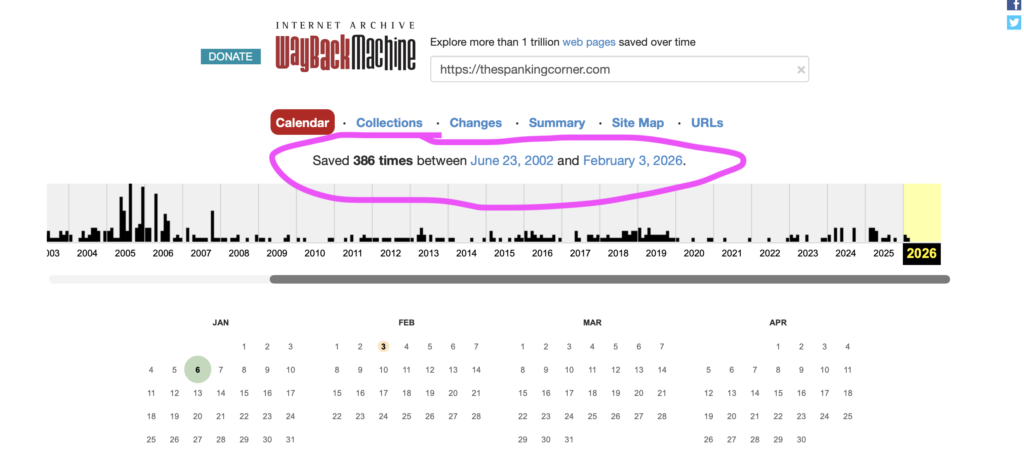
3. Choose a Year
If the Wayback Machine has saved copies of the site, you’ll see a timeline across the top of the page.
Click a year when you think/know the site was active.
For Laura’s, I know the site was open/up a year ago, so I’ve started at 2025.
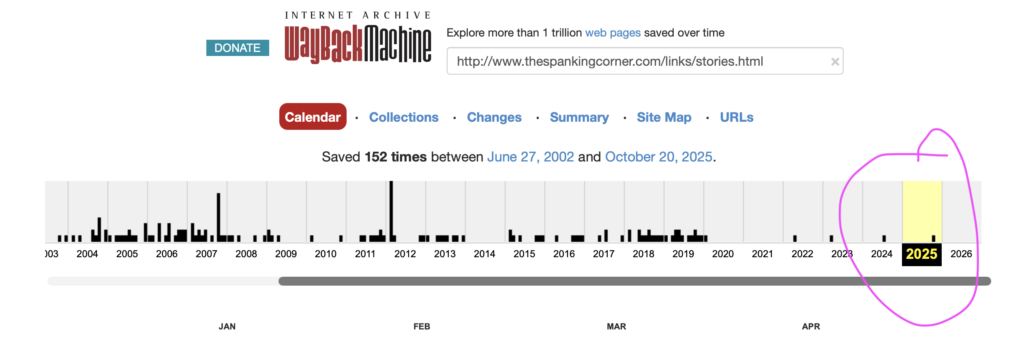
(For many of the older spanking story sites, I’d start somewhere between the late 1990s and the early 2000s, then move forward or backward if needed.)
4. Click a Highlighted Date
After you choose a year, look at the calendar. Dates with coloured circles are days the Wayback Machine saved that page. Click one of those dates and cross your fingers.
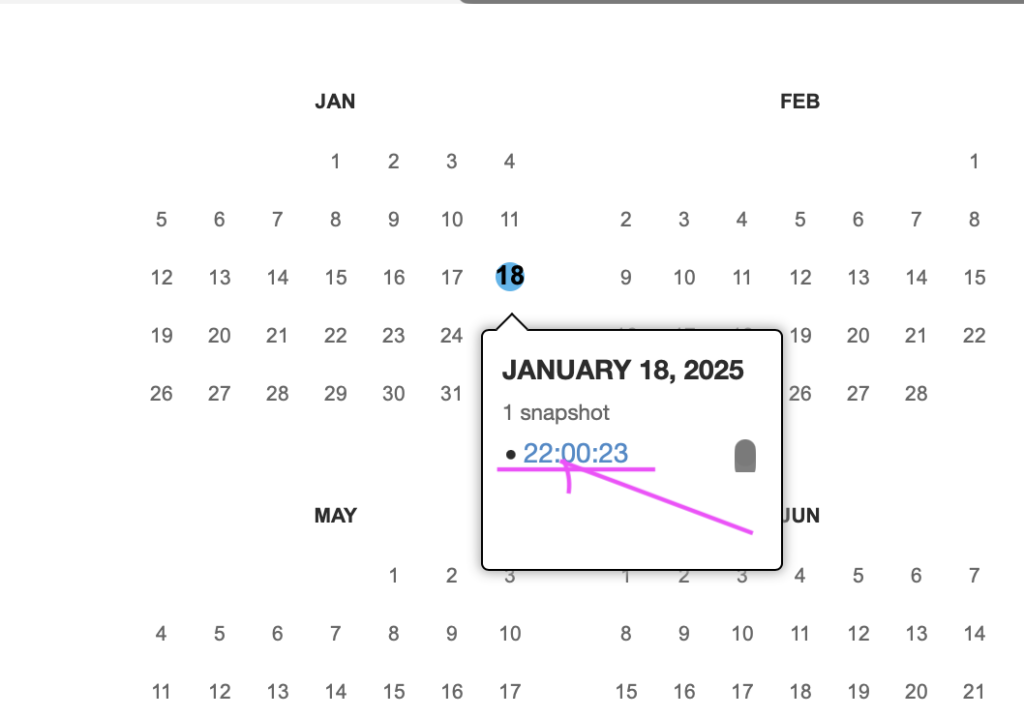
Sometimes you’ll get the old site. Sometimes you’ll get an error page. Sometimes the page will only half-load. That’s normal so if it happens, move on and try another date. This is the most important trick: don’t give up after one bad capture. That’s because the Wayback Machine is patchy. As all Doctor Who fans know, time travel is not an exact science. One saved version may be broken, while another version from a few months earlier or later works perfectly. If a page looks empty, broken, or strange, go back and try another date.
I usually click around several captures before deciding something really isn’t there.2Because sometimes it isn’t. There are former sites whose creators have chosen, for various reasons, to remove them.
Here’s what we get following that January 18, 2025 link:
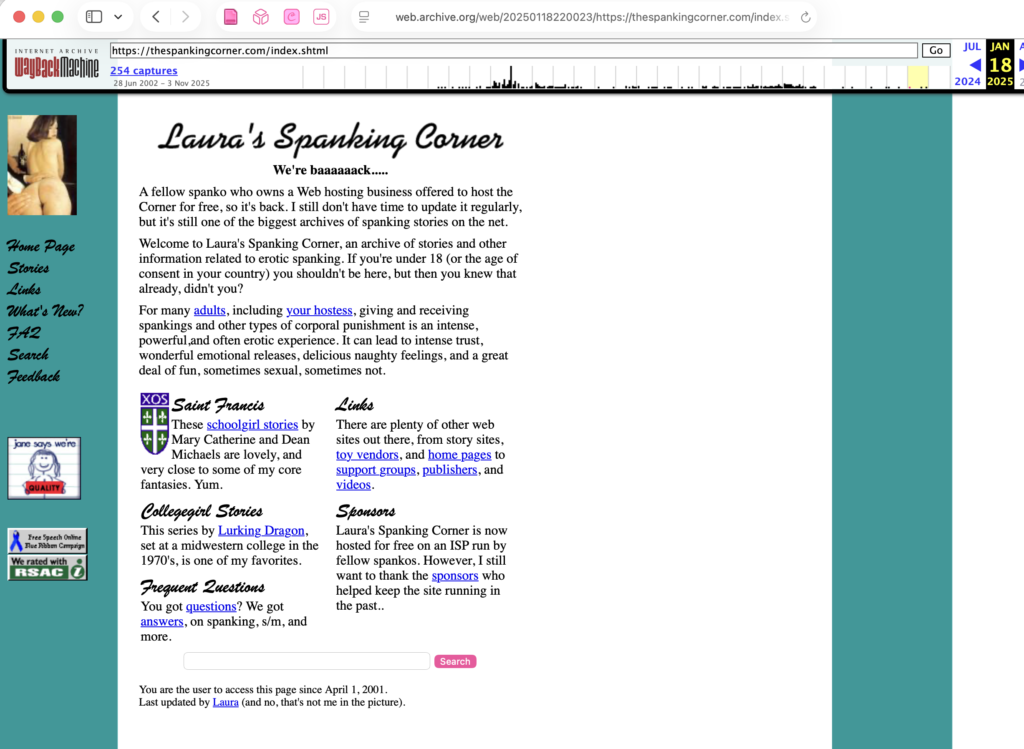
And we’re reading Laura’s site again! Yay!
6. Click Around Inside the Archived Site
Once you find an old homepage, try the links on it.
Look for pages called things like:
Stories
Archive
Fiction
Links
Updates
New Stories
Old Stories
Old story sites were generally simple, many were hand-coded. The front page generally leads to a story index. From that story index there may be dozens (or hundreds!) of individual pages. Again, some links will work. Others won’t.
Below this line are some trouble-shooting tips. These are more suggestions for someone looking for specific authors, years, or stories.
🙂
- If a Link “Breaks,” Copy It
If you click a story link and it doesn’t work, try copying the link address and pasting that into the Wayback Machine search box. Sometimes the Wayback Machine has the story page but doesn’t connect to it properly from the archived homepage. This sounds fussy, but it works more often than not.
- Use Old Link Pages
If you can’t find the site directly, try finding it through another old site. Search engines weren’t great in 1999 (kinda like now?) so our early spanking web pages were linked to each other. This is one of the lovely things about the old web. Our sites didn’t exist in isolation; we pointed to each other. Most sites had pretty detailed link pages, so maybe you can find a vanished site’s URL listed on someone else’s “Links” page.
So if you find an old story archive, check its links page. You may find Laura’s Spanking Corner, Castle Handyman, or another remembered site listed there. Copy that URL and search for it in the Wayback Machine.
- Expect Broken and Missing Pieces
A recovered site may not look exactly as it did when you remember it. Some images will be gone. Backgrounds may not load. Guestbooks may be broken. Some stories may be missing because pages were saved while others weren’t. That doesn’t mean you’re doing anything wrong. Sadly the old web survives unevenly. Sometimes what we get back is a whole house, but for others it might only be one room. Or it’s one shelf, one drawer, or just folded note someone forgot and left under the rug.
- Read With Care and Respect
Privacy and anonymity practices have changed a lot in the past 30 years. Many of these pages were written by people using scene names and pseudonyms. However, it was a lot harder to hide information, especially for posts archived from Usenet. Some may include old email addresses, guestbook comments, or personal details.
Treat what you find with care and discretion. Consider that someone who posted from their university email address as a clueless college freshman in 1996 is now pushing 50 and may not want links to their stories or sites to appear on Fetlife or Twitter or anywhere else.
More later:
This guide is simply about finding and reading old stories. In a later post, I’ll discuss more about what it may mean to preserve, cite, share, or write about these materials as community history. For now the old town isn’t all there, yet some of the doors still open if you can remember where they were.
Would this be, I wonder, a tool for me to find those stories we posted to the group? I haven’t fiddled about with the Way Back Machine yet (despite that I have a Mr. Peabody bobble head on my bookshelf and simply LOVED that show). I think I’ll give it a try.
Sadly… probably not. Because of the mess that Google perpetrated both in the way they took over Deja News and then mixed it with Google Groups, compounded by the alt.sex* hierarchy as a whole not being carried on a number of feeds, ass/sss aren’t very well preserved… yet.* But, depending on when you and MLB posted yours there’s another possibility. EasyNews carries the soc.sexuality.spanking feed from 7/2/2003.
Holy moly! It turned out to be as simple as Google searching “soc.sexuality.spanking + ‘Executive Privilege'” and then doing the same with “It’s My Party.” Wow.
I’m very pleased to have found these. I was even able to read comments, one of which was:
Mija
Apr 6, 1998, 3:00:00 AM
Thanks for posting this. I liked it a lot.
The build-up was really wonderful.
And since I’ve not written you before,
welcome to the group (and if you’re returning
after an absence, welcome back).
Peace,
Mija
(posted and mailed)
How about THAT?
LOL! Holy moly indeed!! That’s fantastic. 🙂 I so rarely have that kind of luck with Google. Maybe buy a lottery ticket?
Now I’ve got to go read them… after I get back from Costco. 🙂
They were posted in parts. I’ll send you the Google docs I created to keep them.